
A Star Is Born
Published: ASIA
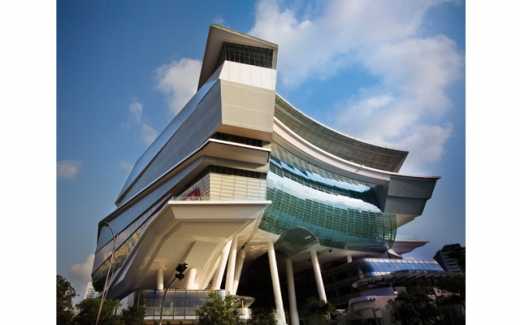
The Star Performing Arts Centre in Singapore is one of the region’s most impressive venues, not least for its technical systems, as Richard Lawn reports.
The 1st of November 2012 marked a significant new chapter for live sound concerts in Singapore. Diana Krall will no longer need to tickle the ivories on a soulless outdoor Fort Canning stage that completely lacks a jazz atmosphere. J-Lo can avoid trying to stimulate a wet, unenthusiastic audience during thunderstorms at Gardens by the Bay. The muffled reverberations of other international artists playing in the acoustically challenging Indoor Stadium, Expo or Suntec City will also now be a thing of the past. The 15-storey development consisting of the Star Vista and the Star Performing Arts Centre (The Star PAC) that has risen above Buona Vista has at last brought the Lion City a state of the art complex that will entice premium acts and sell out audiences alike into its unique space.
Buona Vista and One-North was a wasteland some years ago, but having identified it as a key area of development, the Singapore government laid out ambitious blueprints to totally transform the landscape. Following several years of construction, the boards have been gradually peeled away to reveal Fusionopolis, Solaris and now the colossal Star Performing Arts Centre.
Designed by Andrew Bromberg of Aedas Architects, the titanium and glass structure comprises the performing arts centre and a shopping mall named The Star Vista. The south elevation is completely open and its facilities are clearly visible from the exterior. One can enter under it, or move up through it on a large escalator, transverse around it or climb onto the complex through a series of ramps, escalators, terraces and landscaped greenery. The 38,000 sq-m performing arts centre occupies almost two thirds of the building between levels three and 11. In addition to a 5,118-seat purpose-built performance venue, it also features a 770-seat function hall, an outdoor 300-seat amphitheatre, supporting rooms and a roof-top VIP reception area.
The structure has won multiple architectural awards. Unlike most buildings in Singapore that rely on vast amounts of air conditioning, the design of The Star PAC is highly sustainable. The retail, civic square, outdoor theatre and banquet /meeting room facilities are all open air under the Grand Foyer, minimising the need for air-conditioning, for which the structure encourages air circulation through the space creating a cool, shaded environment. Carefully placed openings allow the shaded Northern face to cool the heated surfaces of the Southern elevation, whilst glazing on the southern face has been minimised and protected by shades. The majority of the glass in the theatre’s main lobby faces east but it is protected from the late morning sun by an external bridge acting as a large sun shade. Finally on top of the facility, a large rooftop garden shaded by trees overlooks a reflecting pool, whilst lush landscaped greenery has been included throughout to highlight the complex as an eco-friendly building.
The S$500 million (US$400 million) investment jointly undertaken by Rock Productions Pte Ltd and Capitaland Retail Project Management Pte Ltd has been a huge leap of faith. Daniel Loh was drafted in as technical director from the nearby University Cultural Centre at NUS in October 2010 when The Star Performing Arts Centre was only three storeys in height.
‘I jumped at the opportunity when it was presented to me,’ he declares. His initial task was to assemble a team whilst working closely with A/V system design overseer Artec Consultants. ‘Luckily, I came in early enough whereby I could work alongside the consultant, building a team of contractors, SIs and suppliers. I was in the centre pulling it altogether like a project manager rather than a technical director. It has been an extremely valuable learning experience in terms of construction and regulations.’
One of the main focuses of attention for Mr Loh was the tender specifications and so invitations were sent out to the leading systems integrators to pitch for the job. He explains: ‘Rock Productions ultimately went for Electronics & Engineering Pte Ltd (E&E) on account of the impressive work they had conducted at the Esplanade Theatres on the Bay and Marina Bay Sands to name but two. They had a long established track record, thorough understanding of the project and offered a comprehensive package. Working alongside E&E made my life a lot simpler as they work in construction and could communicate effectively with other contractors.’
E&E had already been asked to lay the infrastructure works into The Star PAC, in which all the sound, lighting and video cabling had to lay in a labyrinth of conduits.
The brief was for the venue to provide a suite of performance spaces for varied events including broadcasting facilities serving the multi-functional main theatre. In order to spread its appeal to a variety of promoters and clientele, The Star PAC would need to cater for amplified performances including pop concerts, large-scale musicals, theatres, dances, seminars and meetings.
The fibre-optic backbone that exists in The Star PAC is Stagetec’s Nexus Star. The digital audio network and routing systems control the audio sources and distribute them accordingly. Artec Consultants stipulated full redundancy for show performance as being critical in the design alongside broadcast quality audio that could be distributed for live, recording, streaming and archiving purposes. The system accommodates up to 16 boards each with 256 inputs and 256 outputs, which in turn allows for routing a maximum of 4,096 inputs to 4,096 outputs, resulting in more than 16 million cross points. If more I/O resources are required, multiple Nexus Star units can be cascaded. Any input can be freely routed to any output, so point-to-point lines as well as point-to-multipoint sets can be created.
Riedel Artist 64 and 128 intercom solutions have been installed throughout the facility, offering further redundancy should it be needed. The digital system connects the entire facility network from the main theatre to other outdoor venues, the amphitheatre, the function hall, supporting rooms, studios and all recording suites. Its network infrastructure is based on highly modular matrix mainframes, for which up to 128 ports can be accommodated in a single frame and up to 100 frames can be connected to a redundant dual fibre-optic ring resulting in a maximum matrix size of 1,024 by 1,024 intercom ports. Up to 50 artist intercom key panel systems can be trunked via conventional telephone, ISDN or VoIP trunk lines. Throughout the venue from the broadcast suite to the main theatre rear sound control room, Artist key-panels can be identified by their bright, dimmable eight digit alphanumeric LED displays with clear labelling of destinations under all lighting conditions. A ClearCom digital wireless intercom system is used for live performances in the main theatre.
No fewer than 10 DiGiCo consoles grace The Star PAC including three SD7s in the main theatre serving front of house, monitors and the sound control room, together with a new SD5, two SD8s (one for the outside amphitheatre), two SD9s and two compact SD11 versions.
‘I am familiar with the DiGiCo SD workflow as I used an SD8 at UCC,’ discloses Mr Loh. ‘We did our research and found that most of the top 20 US tours used DiGiCo consoles.’ The SD7 consoles are linked to the two SD racks in the communications rack room via a fibre link. All analogue signals from the stage are sent to the communications rack room where they are spilt between the SD racks and the Nexus star via 15 XTA DS8000 splitters. This active audio distribution system offers a dual redundant power supply, OB one to many split switching and 48V safe functions to prevent tampering.
From here, the patched signals together with those emitting from the Nexus routers are fed to the amplification and loudspeaker systems, OB vehicles and anywhere else on the fibre network including a recording studio with an SSL Duality console and Pro Tools. Furman PS-Pro series power conditioners have been installed into the racks for easy power on and power off sequencing. These will be updated to the latest Furman Blue Bolt 3500 processors which are currently used at the amplifier racks located on catwalks above the stage, which have contained the AC and in doing so have lowered the amplifier noise levels.
Ultimately, the selection of loudspeakers presented Mr Loh and his selection committee with a difficult decision. ‘At the end of the day, we could have selected any of three speaker systems, but just as we opted for DiGiCo on account of the brand’s reliability, ease of use and popularity amongst technical riders, we chose L-Acoustics for much the same reasons. However, I really liked the power and the punch of the K-1 for rock concerts and we can switch between AES and analogue signals should one fail.’
Based upon Wavefront Sculpture Technology (WST), the K1 line source was originally packaged as a complete system for the touring market, but is increasingly penetrating into many high-end performance theatres. Although The Star is modular in design, an L-C-R configuration is preferred. The L-R arrays each comprise 12 K1 three-way, quad-amplified enclosures per side augmented in the lower hangs by a further five Kara cabinets, whilst a central cluster consisting of 14 Kara cabinets covers the central seats in the theatre stalls and two balconies. The Kara cabinets are completely compatible with the K1 line sources.
The lower frequencies of what is a four-way system can extend down to 25Hz and these are provided by 16 SB28 dual 18-inch bass-reflex tuned subwoofers, placed eight per side in cardioid fashion (six front facing and two rear facing). The control and amplification of the FOH system is managed by the LA8 platform with DSP filtering that includes crossover functions, system EQ, and L-Drive thermal and over-excursion protection of the transducers.
The distance from the stage lip to the last seat on the second circle is 56m, but simulations provided by proprietary Soundvision software ensured that fills were required. The under balcony fills in the rear stalls seating area is thus covered by ceiling suspended 8XTi Architectural Series point source coaxial loudspeakers. The seats in Circles 1 and 2 required an increased SPL and this is provided by 12-inch coaxial 12XTi speakers, producing 100-degree axi-symmetric directivity output. Finally, seven 8XTi speakers provide front-fill dispersion. For monitoring on stage, a selection of 115XTHiQ, 12XT and 8XT speakers can be deployed via various microphone points together with SB18 subwoofers for drum fills.
In its role as distributor, E&E supplied 40 channels of Shure’s Axient Wireless Management Network, 24 channels of UHF-R wireless and 20 channels of ULX-D digital wireless microphone systems, in addition to 28 and 12 channels of PSM 1000 and PSM 900 personal monitor systems respectively.
‘As a multiple venue performing arts centre they needed a system that was scalable and yet robust and reliable and able to manage the complex RF environment,’ explains E&E’s deputy managing director Gary Goh. Shure Axient is designed to ensure uninterrupted wireless transmission, most notably its ability to detect and avoid interference. It also handles frequency coordination through its Wireless Workbench software and the AXT600 Spectrum Manager.
The function halls below the theatre are very flexible can be sub-divided into five separate partitioned rooms for various sized seminars, presentations, weddings, events and dinners. An overhead grid allows lighting and L-Acoustics coaxial XTi speakers to be suspended relatively quickly, although a Kara line array can also be set up separately. Crestron Control provides the users with access to limited functions such as dimming the house lights and employing the motorised projectors. Elsewhere at back of house, a Community ceiling speaker system powered by Powersoft 4-channel Ottocanali amplifiers provides zoned BGM and paging to the various dressing and rehearsal rooms, studio and editing suites.
From Monday to Saturday, the main theatre can be hired out for any performance, but on a Sunday it is the domain of 30,000-strong membership New Creation Church (the owner of Rock Productions Pte Ltd). So large is the church that those worshippers who cannot acquire a ticket for The Star PAC online during the week instead participate in the spectacle at Marina Bay Sands, which acts as an overflow, receiving its A/V transmissions via the broadcast suite. Adjacent to the recording studio, editing suites connected by the fibre network are used by the church and artists alike for their own needs.
‘It can be hectic for artists performing on a Saturday night,’ discloses Mr Loh. ‘Their entire production needs to be out by 3am on Sunday, so it has to be quick.’ Luckily, The Star PAC is equipped with two 3.2m height lifts measuring 2.5m wide by 6m and 7m deep between the awaiting trucks and the stage. ‘Taking sets, cars, PA systems, rigging, you name it in and out of here is a breeze,’ Mr Loh adds. ‘The nature of this venue demanded this in the design.’
Another time saving feature that has been integrated into the very veins of The Star PAC is a rather unique, extensive and flexible cable pass infrastructure. ‘If a production wants to deploy its own cables, it can,’ furthers Mr Loh. ‘We have a series of pipes built into the concrete between levels five and eight in addition to between FOH and the stage and down to the loading bay. A grip in the pipe takes the cable to wherever you need it to be located via draw ports.’
When the construction site was suddenly transformed to a venue courtesy of a government licence, the clean-up had to be completed in less than 96 hours. When David Foster and Friends opened their show, becoming the first artist to perform in this impressive theatre on November 2nd, you could almost hear a long collective sigh of relief burst through the K1 front of house system.
‘I wasn’t just nervous, I was praying down there at FOH,’ Mr Loh recalls. ‘But nothing went wrong. I have to say that it was one of the most satisfying nights of my life. We had been working over two years to get to that point and everyone involved should really take credit for that. Now we’re seeing some great artists booking the venue in 2013 through their promoters.’
The Star PAC is definitely rising and finally allows Singaporeans an opportunity to witness and hear jazz, rock, pop, classical concerts and musicals as they were always intended.