
Canberra turns 100
Published: ASIA
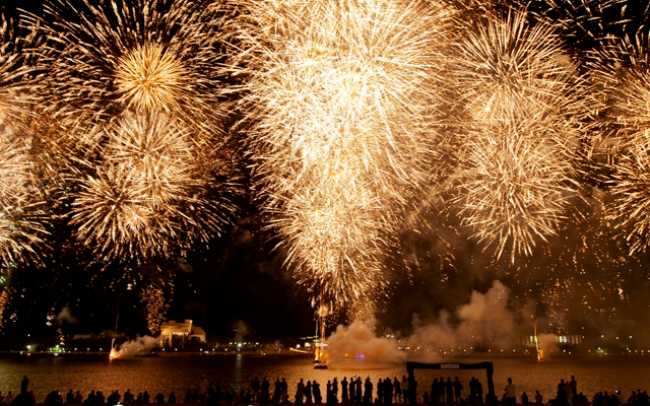
2013 marked 100 years since the Australian capital was officially named ‘Canberra’. Providing the backbone for the city’s big day was Riedel. Alice Gustafson reports
Having reached the grand old age of 100 this year, Canberra certainly had reason to celebrate during a huge one-day gala event dubbed ‘One Very Big Day’. Tens of thousands of Canberrans made a beeline for the capital’s Lake Burley Griffith area to celebrate the century that has passed since Lady Denman announced that the Australian capital would from then on be known as Canberra.
Cue the entire city transforming into a grand stage to celebrate the milestone, in particular the site for One Very Big Day itself, which was crammed with live music across five stages, various cultural displays, fireworks, roving artists, musicians and performance artists on boats that circled the lake.
Screencraft was tasked with creating and delivering content to the three main stages and four big screens, with Riedel Australia providing the elements that are often forgotten about, yet key to the success of such large-scale undertakings: the wireless camera and fibre backbone systems.
‘This was the largest deployment of wireless cameras that Riedel has done in the country,’ states Jason Owen, senior project manager at Riedel Australia. ‘The site was 2.5 sq-km, spread around the shores of Lake Burley Griffith. All in all we ended up using 5km of single-mode fibre.’
Three wireless broadcast cameras were able to roam freely around the shores of the lake, transmitting the action back to the MCR at the National Capital Exhibition. High-gain antennas placed at the screen sites picked up the signal from the cameras. The ASI signal was then transmitted back to the MCR via the MediorNet fibre system, where a Riedel ASI switch automatically selected the strongest signal.
From there, two programme feeds for the multiple screens were mixed on Screencraft’s Ross switcher. This included the pre-packaged content, broadcast cameras at the main stages and the roving cameras.
The backbone
Signal transport and routing was key to the success of One Very Big Day, but it is a process that is often not given enough credit, as Cameron O’Neill, Australian solutions manager for Riedel explains: ‘Backbone infrastructure is just that: backbone. You can often walk, run or play sports without thinking much about your backbone, but it certainly plays a big part in your flexibility and the ability to perform. MediorNet helped in this event by allowing one common type of cabling: single mode fibre. This lowered the amount of time spent running cables, and when things went awry, it only required one set of tools for the whole network.
‘The ability to route all signals anywhere also helped,’ he adds. ‘When the client changed their mind and added a second programme feed to all of the screens, MediorNet was able to send that feed to any screen with the click of a mouse, instead of having to run another 2km of cable.’
In total, the event used eight MediorNet frames (comprised of 16 ASI and 12 HDSDI streams), 192 RockNet channels, 218 Artist IOs, Motorola UHF antennas (comprised of seven Duplex, eight Simplex and 165 radios), four RF camera systems, LAN control of four Sony PTZF cameras, and a huge 5km of single mode tactical fibre.
‘We basically bought out all of the available fibre in the country!’ nods Mr O'Neill. ‘Also, the size of the team that pulled off such an event was interesting, as we only used four Riedel technicians. From my point of view, this event was proof of the combined Riedel concept: linking audio, video and communications together over a single backbone. This provided Screencraft with a single solution to manage their complex event.’
‘Because MediorNet is a multi-technology platform, it can be deployed where SDI, comms, audio and LAN are required in one simple solution,’ concurs Mr Owen. Indeed, instead of dealing with three companies (camera, comms and video distribution), Screencraft was able to reduce its costs whilst maintaining the level of production required.
Aside from the massive undertaking itself, the four-man Riedel team faced a few additional issues during the day’s festivities. ‘The fibre across the lake was cut at one point,’ reflects Mr O'Neill. ‘The only way to fix this was to splice the cable in the water!’ Adding to this was a powerful RF transmitter in Canberra that caused issues with some of the UHF radio channels. However, some quick re-programming limited the damage caused by this.
Reliable audio
As important as the backbone infrastructure was, One Very Big Day also needed to rely on an appropriate sound system and an experienced team. Local production company Eclipse Lighting and Sound was awarded the tender, looking after the audio, lighting and LED screens on the main Symphony Stage, as well as the Reconciliation Place Stage.
‘This was a very large project for us, and we had to work with many teams to create the results the client wanted,’ reflects Eclipse director Chris Neal. ‘A large team worked very hard for the last 18 months to bring Canberra a very big day of entertainment. With such a large crowd and with expectations so high it was crucial that all the equipment worked perfectly, and first time.’
The event’s star attraction was the Symphony Concert, halting performances from all other stages. Crucially, the feed from the stage was broadcast to all screens on site, the orchestra’s symphony having been composed especially for the celebration.
To ensure things ran smoothly, Eclipse used a DiGiCo D5 for the main orchestra console, a Midas Heritage 2000 for the choir and a Yamaha M7CL for the pre show acts. The main hang consisted of 12 Electro-Voice XLC DVX line array cabinets and six Electro-Voice X-Subs per side, hung from 16m high towers integrated within the stage. Speaker processing was completed using Electro-Voice DX46 processors with FIR filters, and 16 Dynacord H5000 amplifiers powered the system.
The first delay hang was rigged from 10m tall truss speaker towers from Eclipse’s inventory, and comprised of eight XLC DVXs and four X-Subs each side. Speaker processing was completed with Klark Teknik DN 9848s, and the cabinets were powered by 10 H5000s.
The second delay hang comprised 16 XLEs and two X-Subs, powered by six Electro-Voice CP3000s amps – processed by Klark Teknik DN9848s. Meanwhile, a Midas Siena 480 console, 12 Electro-Voice XW12s and eight Electro-Voice P1200s covered monitors.
‘For the main symphony concert, the choir was placed on the stage in front of the hangs, which is every audio guy’s nightmare!’ laughs Mr Neal. ‘We decided to hang 12 cabinets a side to enable line array characteristics and to give us good pattern control to keep the levels offstage as much as possible. However, we were very pleased with the performance of the equipment, and both clients and acts commended on the high quality audio production.’
‘The whole of the country was looking to Canberra on the centenary,’ asserts Mr O'Neill. ‘If the gear didn’t work perfectly then Screencraft would have lost everything; screen feeds, camera feeds and audio distribution, but with the in-built redundancy there were no glitches. At one point a generator even lost a neutral, frying one of the LED screens! But the MediorNet and RockNet at that location kept on ticking over, meaning that there was at least audio at that stage.’
All in all, Screencraft was able to reduce its costs whilst maintaining the level of production expected by the client. ‘We’ve now proved that the “pie-in-the-sky” service that we deliver to clients like Formula 1 and the Eurovision Song Contest can be delivered here,’ smiles Mr O'Neill.
www.eclipselightingandsound.com
www.screencraft.com.au
www.riedel.net