
CMI designs spatial soundscapes for RMIT
Published: ASIA
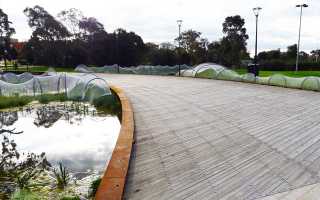
AUSTRALIA: Today’s university students may be wired for sound as they cross campuses between lectures and seminars, but RMIT Bundoora has demanded their attention courtesy of an innovative outdoor sound gallery. The first in a planned series of multi-channel soundscape systems for RMIT campuses, the Bundoora Soundscape System was installed as part of the University’s Bundoora Pedestrian Spine project, which is a new walkway connecting the main road with the campus through reclaimed wetlands. As eerie spatial audio emits upwards from the 40m bridge crossing, the attention of the students is guaranteed.
The 20-channel soundscape system was installed along the edge of the bridge, heavily concealed behind detailing of the structure. Sixteen One Systems IM103 speakers receive multitrack signals from a Mac Mini computer installed in a weatherised control rack sunk into concrete adjacent to the path leading to the bridge. A total of 19 sound works from the RMIT Sound Art Collection are currently used, including a series of new commissions and acquisitions specific to this site.
The entire project was supported by RMIT vice chancellor Margaret Gardener, for which the project team was given just six weeks to provide the multi-channel sound bridge. ‘It has extended the life of many exhibits, which are mainly experimental sounds,’ explained SIAL Sound Studios and Artistic Advisor to the RMIT Sound Art Collection Dr Lawrence Harvey. ‘It ensures that the life of many exhibits endure and are heard by a new audience. In addition, it is making students aware of the physical space they are walking en route to lectures.’
At the heart of the system is Reaper, which is an acronym for Rapid Environment Production and Recording and a MAX / MSP patch. Individual Reaper projects hold each multi-channel work along with their unique channel mappings, whilst the Max/MSP patch generates a daily playlist and ‘calls’ the Reaper projects in that order ensuring no two days feature the same playlist.
Audio supplier and designer CMI Music and Audio worked closely with Dr Harvey, RMIT gallery director and chief curator Suzanne Davies, collections coordinator Jon Buckingham, Spatial Information Architecture Laboratory (SIAL) Sound Studios researcher Jeffrey Hannam and spatial audio consultant Stephen Adam. Devoted to auditory-based research, teaching and practice, SIAL Sound Studios are home to some of Australia’s most progressive acoustic design, sound performance and soundscape research.
The delicate process of supplying the 100V sound system, and internet connectivity to the middle of a reclaimed wetland was designated to Factory Sound. Four XTA Electronics iCore Ti processors provide DSP to the Dante networked speaker system via Ti-breakout boxes, which is powered by a combination of MC2 Audio Ti1500 and Ti4250 amplifiers.
www.cmi.com.au
www.factorysound.com.au
www.rmit.edu.au/architecturedesign/sial/soundstudio
www.rmit.edu.au/rmitgallery