
Sennheiser guidePort units deployed for Gandhi experience centre
Published: ASIA
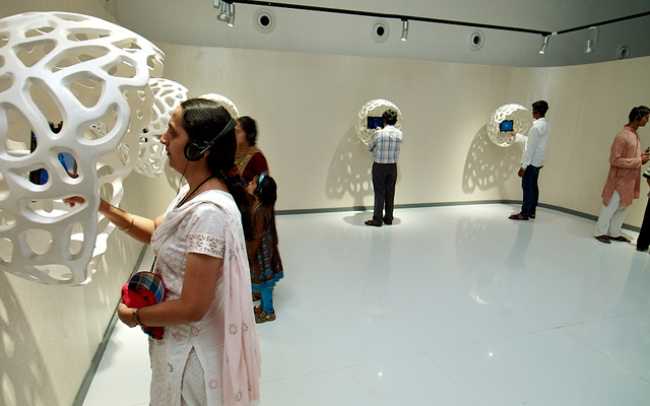
INDIA: Integrated Digital Solutions Private Limited (IDSPL) recently provided the Khoj Gandhiji Ki museum – also know as the Gandhi Experience Centre – with 150 upgradable Sennheiser guidePort units for its visitors. Set up by the Gandhi Research Foundation in the city of Jalgaon, the museum guides a visitor through Gandhi's life and teachings through various interactive, multimedia and audiovisual mediums.
IDSPL was consulted after the Gandhi Research Foundation had exhausted all avenues for a single point responsibility team. The original specification called for a 60-minute audio guide tour solution available in three-languages. This had to cater for 150 visitors – keeping in mind that some may not be technology-savvy.
Therefore, while configuring the hardware for the Sennheiser guidePort solution, due consideration was made to include an usher-based team leader complete with his own unit to provided a guided tour. This also allows a visitor to experience the audio tour at his or her own pace.
IDSPL described the project to be ‘challenging on the creative contents side’ as the base research material was from authors other than Gandhi himself. To overcome this, the company’s creative team wrote and storyboarded an experience based on the information they had to work with. By the end of the process, the base script was rewritten three times, two languages were rerecorded twice and the narrator was selected after full versions of the recording were recorded by four voice-overs.
This left little time before the inauguration by the president of India was due to take place, and IDSPL stated that ‘the work in the mixing studio continued round the clock and the audio tracks were loaded through FTP – with IDSPL engineering virtually building the whole audio tour block by block.’
Post implementation, two additional languages were to be loaded, and the creative team at IDSPL introduced the idea of integrating the audiovisual content, 3D projection and lighting with the audio – an idea that was not originally conceived and perceived by the client. With the aim to perfect the synchronisation, hardware solutions were considered and the sound design was re-done to provide seamless integration between the audio and video – with the lighting to soon follow. Following the success of the project, the client contacted IDSPL to supply a further 100 Sennheiser guidePort personal units and two additional languages.
‘At Sennheiser, we believe in the power of sound and the emotions that it can bring alive,’ commented Vipin Pungalia, vice president, sales and marketing, professional segment, Sennheiser India. ‘The Gandhi Research Foundation museum project was a challenging yet fulfilling one for us at Sennheiser India. We are happy to bring alive the memories of the father of our nation through guidePort technology.’
‘The technology is catching up in India and museums and art galleries are realising the rich experience guidePort can offer,’ added Anshuman Dubey, senior product manager, integrated systems, Sennheiser India.
‘We are in the business of providing services in the leisure and entertainment sector, and have always put the satisfaction level of the end-user in the forefront, and the ideas of the client or operator in the background to begin with,’ stated Mukesh Bhargava, CEO, IDSPL. ‘It is only after the initial interaction and brain-storming with the team and the client that we discuss the list of optimal requirements in terms of hardware, logistics and the experience of the visitor,’ he explained.
‘We set very high goals, not just in terms of the ease and quality of the experience of the visitor, but also in terms of a long-lasting impact on the visitor,’ he continued. ‘We opted for Sennheiser’s guidePort due to its multiple functionality, as well as the flexibility to upgrade and upscale at any time without scrapping any old installations. We are glad we have found a very versatile yet rugged solution, and we are equally glad that we agreed to take up this assignment. Although there was a tight time frame and the expectations were a lot higher than usual, this has become a bench mark installation.’