
Sennheiser launches ‘masterpiece’ Digital 9000 wireless system
Published: ASIA
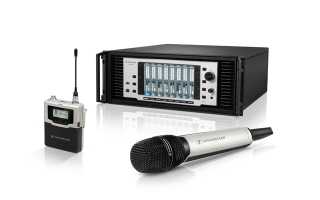
WORLD: Following a 10 year development effort Sennheiser has officially launched Digital 9000, a digital wireless system operating in the UHF band that has been described by wireless microphones portfolio manager Kevin Jungk as ‘a masterpiece, both in the digital and the wireless realm’.
While the official launch took place at IBC 2012, the system was previewed in the days before the Amsterdam exhibition at a special invitation-only event in Hannover, Germany, for which distributors, customers and media from around the world assembled. An earlier product introduction also took place at BIRTV, led by Sennheiser China.
Company chairman Professor Dr Jorg Sennheiser was in attendance at the Hannover launch, reflecting his own personal commitment to the Digital 9000 project over the decade of its creation. ‘Professor Sennheiser backed it up from the beginning and I think that without his support the project would have been stopped,’ explained Claus Menke, portfolio manager of the Sennheiser professional systems division.
Promising the transmission of ‘completely uncompressed audio, artefact-free and with superb dynamics’, Digital 9000 is primarily targeted at broadcast and theatre applications plus the live events sector. It principally comprises the EM 9046 receiver, the SK 9000 bodypack transmitter, a suite of accessories and the SKM 9000 handheld transmitter.
Crucially, the SKM 9000 is compatible with a broad range of capsules including all evolution wireless G3 and 2000 Series heads, Neumann’s KK 204 and KK 205, and four dedicated 9000 Series capsules. The handheld transmitter is also notable for its extreme rejection of handling noise, boasts an 88MHz switching bandwidth and includes a command switch for off-PA communication with the engineer.
Alternately the SK 9000 bodypack can be used with any clip-on or headset microphone with a 3-pin Lemo connector, and has a line input for instruments.
At the core of the new system’s technology, meanwhile, lie two operational modes – Long Range (LR) and High Definition (HD). LR mode has been designed to operate in difficult RF conditions whilst delivering high quality audio via a new proprietary digital audio codec. It is described by Sennheiser’s Gerrit Buhe, who was central to the system’s development, as ‘our workhorse for all critical situations. It offers a high level of robustness for tough RF scenarios with many sources of interference’.
In contrast, HD mode will reportedly ‘transmit entirely uncompressed, artefact-free audio, as if a high-quality cabled microphone were used’. Following the Hannover launch, Claus Menke explained to Pro Audio Asia that the two modes were created out of necessity rather than intention, when early field-testing revealed that the HD mode was not appropriate for critical RF environments.
‘It would sound better if we could say that we planned both modes but they were created out of necessity,’ he explained. ‘Our goal was to go beyond where other companies have already been in terms of digital transmission. The sound is incredible with the HD system but it didn’t fly in a critical RF environment, which was very tough. So we started developing the data-rate compression that we have in the long range mode – creating everything from scratch.’ He added: ‘With Sennheiser you expect it to be bullet-proof in every environment’.
Other key features of Digital 9000 include IR synchronisation between receivers and transmitters plus an antenna loop-through for creating larger receiving systems. The EM 9046 also receiver does away with cable loss, automatically measuring RF loss between the receiver and the booster and then adjusting the gain accordingly.
The EM 9046 itself boasts three display modes using an icon driven menu and can accommodate up to eight receivers internally. It covers the UHF range from 470MHz to 798MHz (328MHz bandwidth) and offers a choice of transformer-balanced analogue or digital AES3 outputs, or a mixture of both. To help simplify the system’s set-up, Sennheiser has added a graphical spectrum analyser to scan available RF plus an RF level recorder for optimising antenna positions, while antenna boosters can be controlled from the receiver. Up to 10 complete system configurations can be stored.
Equally important is the AB 9000 antenna booster which uses eight filters to block unwanted signals, offers a maximum gain of 17dB and is available either standalone or integrated into the A 9000 omnidirectional antenna or AD 9000 directional antenna.
Notably, the system is not cognitive. ‘We had a Bluetooth remote channel in the specification in 2006 but we had a lot of discussion with the development team and we had to make a trade off,’ explained Mr Menke. ‘We have a lot of power requirements inside the system because for the HD mode we have a very linear operating point for the components inside. As a result, if we had put in the remote channel then we would have sacrificed the operating time and reached a certain limit where it was unacceptable.
‘We say that four and a half hours of operating time is the absolute minimum that we have to provide so while it would be nice to have the remote channel, in a properly set up system you currently don’t need it – it’s not mandatory.
‘That’s not to say that we’re not looking into it and maybe it will be an option in a system that doesn’t require so much power. But for now we decided that we wanted pure sound – the system is made for that – and in the environments were we expect it to be sold you do not expect sudden changes in the RF.’
Having now launched the system, Mr Menke concluded that the hard work was only just beginning in terms of introducing it to the market: ‘For the time being both Sennheiser and our customers have to go through another learning curve. It’s now about the application of the system. We cannot simply bring in the system on a Monday afternoon and by Tuesday you go back to the show – that doesn’t work. This is something we all now have to learn – the differences that have to be made to reach the level that is possible with Digital 9000’.