
Something for everyone
Published: ASIA
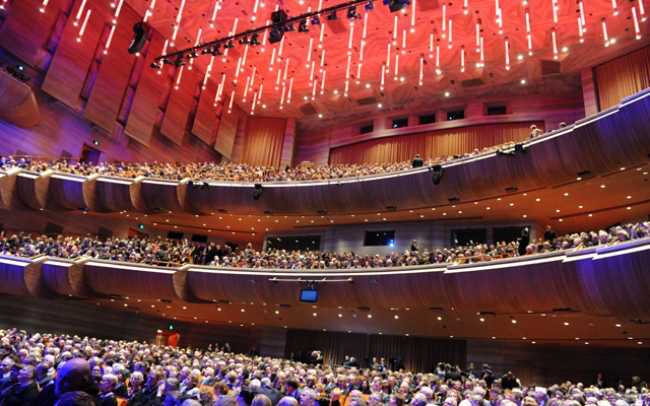
Hamer Hall needed a sound reinforcement system that could cope with a range of musical styles, leading to an extensive installation with a focus on acoustics. Alice Gustafson finds out more
Home to the Melbourne Symphony Orchestra and the preferred Melbourne performance venue for the Australian Chamber Orchestra, Arts Centre Melbourne’s Hamer Hall has a lot to live up to with regards to having a top-notch sound system. This is why the Victorian Government saw fit to invest in an extensive audio reinforcement solution for the esteemed concert venue – forming a major part of an overall AUD$136.5m redevelopment project that saw the venue close for two years.
Originally designed as a venue that would host symphonic performances alone, 30-year old Hamer Hall has long since offered a wider range of performance types, requiring adaptable acoustic conditions and short changeover times. As a solution, an extensive acoustics system was designed in the auditorium that allowed the project to work around the heritage-listed interior. In addition, four different Meyer Sound FOH speaker systems were commissioned to specifically cater to each style of performance.
Acoustics
Arts Centre Melbourne undertook significant measures in both the redesign of the geometry of the hall and the selection of materials used to provide the best acoustics possible, and contacted Marshall Day Acoustics and Kirkegaard Associates to serve as acousticians.
Included in this was the elimination of the balcony arms and walls near the stage, as well as an array of acoustic reflectors suspended above. Meanwhile, the widths and alignment of the stalls were also reduced to improve acoustic envelopment and sound clarity for the audience and performers, whilst acoustic surface treatment was provided to eliminate any acoustic anomalies.
The hall also now boasts an extensive technical zone that hangs above the stage which houses rigging, lights and sound equipment with flying acoustic operable reflectors. Meanwhile, new solid side and back walls line the stage – complete with bronze panels to bounce a clearer sound to the audience, assisted by a new ‘live’ stage floor mounted on acoustic pads.
Not stopping there, the walls have been painted with a special render applied at thicknesses of 2mm and 3.5mm to improve the way frequencies resonate in the room. Even the seats have been selected with their acoustic properties in mind. Vibrant brushed velvet orange fabric chairs now reside in the 2,464-seat hall, and every part of the seat, such as the density of the foam, the exposed plywood back and base and the permeable fabric, were considered and chosen for their reflective and absorptive qualities.
Installing the four-mode sound system
Clearly not cutting any corners, the acoustic treatment was immediately followed by the sound reinforcement system installation, centring around an extensive four-mode Meyer Sound solution.
Naturally, Meyer Sound Laboratories took care of the acoustic analysis and design, whilst Bob McCarthy was tasked with system commissioning and time alignment. Meyer Sound Australia supplied the speakers, KLM completed the fitting and speaker rigging, and Elecraft completed the cable and fibre system.
‘A combination of price, suitability regarding size and weight, sound quality, preference from end users and ongoing service were deciding factors when choosing the audio equipment,’ explains Frank Ward, head of production, Arts Centre Melbourne. ‘One of the advantages of the speakers was the range of boxes, from very small to large, which meant we could configure the room accordingly.’
FOH speakers comprise two clusters of eight Meyer Sound Milo arrays with one Milo 120 on the bottom each side, which can track up and down stage to allow for different seating/stage configurations. Eight Mina Curvilinear array speakers serve as the centre cluster, whilst four delay configurations are made up of six Melodies with one 600-HP sub.
For front stall fills, eight M1Ds, 13 MM4s or 11 UP-4XPs are used depending on the requirements of the performance. Meanwhile 12 UPM-1P compact speakers serve as under balcony fills, with another 12 for under circle fills. For the stalls focus system, four 700 HP subs were installed along with 10 M'elodie arrays, whilst the lower niche is served by two Meyer CAL Column arrays, 12 Minas and two more 700-HPs, whilst the upper niche serviced by a further eight Mina arrays.
The system can be configured in various ways, ranging from a discrete announcement system to full range high power concert solution. Mode one is a visually discreet security announcement system, and mode two serves as the centre cluster system – designed for use with conductors on lapels or for when a small discrete sound solution is required.
Moving on to mode three, this is a standard production system which is used for shows that require a clean look on stage, but need higher levels than the previous systems. Mode four is much the same as three, but uses a ground-stacked configuration for the stalls with two 700 HP subs a side in a cardioid mode with five Melodies on top. The Milo and M'elodie subs can be moved upstage when the pit sets go on.
‘Ensuring an even coverage across the whole room for amplified sound while making sure the room worked acoustically was challenging,’ Mr Ward admits. ‘This was due to the many variances in types of performance within the hall, as we go from plain acoustic, to voice announcements, to light amplification, to large scale concert productions.’
‘Specific challenges were that the side speaker recesses needed to provide coverage to the stalls without impacting on the aesthetics of the room, as well as the transferable left and right main PA integration with the new rigging system,’ explains Nick Carroll, operations manager sound. ‘Positioning the centre cluster with the new rigging system also proved challenging, as was designing the new patching system and ensuring we future-proofed the installation as much as possible. We also had to ensure that our operational staff had input into the design – and we had to find storage for all of this equipment!’
Moving on to the console network, this comprises a fully redundant Optocore fibre ring connecting the front of house console, foldback desk and recording console. A DiGiCo SD7 sits at FOH at the rear of the stalls, whilst three DiGiCo SD racks provide 112 inputs on stage and 24 inputs for the tech zone.
Elsewhere, Hamer Hall’s foldback system comprises another DiGiCo SD7, seven Meyer Sound UM1-Ps and six Meyer UM1000-P low profile monitors, four Meyer MJF212s, two Meyer UPA1Ps, one Meyer 500-HP and three Yamaha MSP5A effects monitors.
The team was able to breathe a collective sigh of relief upon completion and testing of the system, as Mr Ward explains: ‘We are very happy with it and its integration with the changed acoustics within the room. It is operationally a much easier room to work within now; it is faster for changeovers and repeatable systems of work and it has a better audio quality.’
Equally enthusiastic is Arts Centre Melbourne chief executive Judith Isherwood, who comments that ‘having Hamer Hall back is music to our ears and we are absolutely delighted with its stunning transformation’.
‘This is a great moment for Victorians,’ concurs a proud Denis Napthine, minister for major projects. ‘Our wonderful hall had begun to lag behind other concert halls around the world, and this project has transformed it into a first-class contemporary facility. Now Hamer Hall is more accessible, provides a better experience for audiences, and it will continue to attract and present a wide range of top international and local performers for many years to come,’ he smiles.