
Underground sounds
Published: ASIA
Super-clubs dominate Korea’s nightlife, but smaller venues are emerging to champion underground music, as Barney Jameson discovers at Club Mute.
‘In the Korean club scene, we’re kind of upside down. In general elsewhere the small underground clubs start and then get bigger and bigger, but in Korea the big clubs opened quickly and the smaller clubs disappeared,’ says Dji Ujn, better known to the clubbers and dance music fans of Seoul as DJI.
A well-known personality to those who venture out after-dark in search of a party in the South Korean capital, the DJ is sitting at a table within Club Mute, the newly opened nightclub in which he is serving as a resident performer and, perhaps more importantly, as music director. As such, he is a man with a mission to introduce Seoul’s rapidly expanding club scene to the joys of a more boutique clubbing experience, where the music is what matter most.
‘Now the small clubs are reappearing with their own music, and Club Mute is one of those underground venues,’ he continues. ‘Club Mute is newly opened and it is based on techno and house music. Our direction is introducing new and different styles to Seoul – more edgy music but in a way that Korean people can enjoy. We’re converting it to a Korean style.’
Located in the Itaewon district of the capital city, Club Mute is at the heart of Seoul’s most popular tourist area, surrounded by bustling streets and busy bars. It has an advantage over its nearby rivals, however, thanks to its position as one third of a new high profile leisure development named District. On the ground floor of the converted warehouse in which District is located is the Prost pub and restaurant, which draws in passers-by. Should they venture upstairs, meanwhile, they will find themselves presented with a choice of either turning right to soak up the luxury and champagne of the Glam Lounge, or turning left for Club Mute’s heady offering of cutting edge music and super-fashionable clientele.
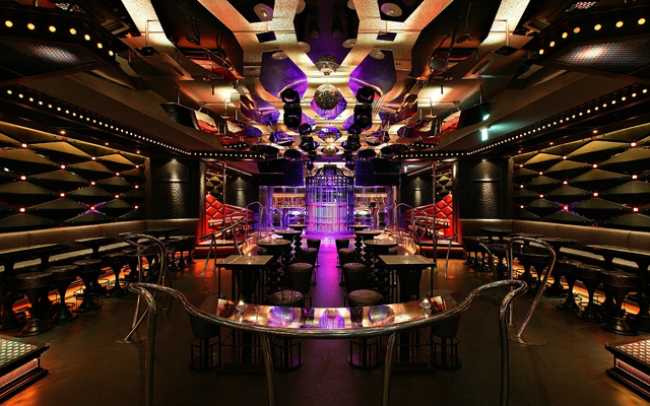
The venue itself boasts few of the trappings of its larger competitors. The biggest clubs in the city boast vast dance-floors overlooked by towering, LED-draped stages where DJs perform to a sea of party-goers every weekend. In contrast, visitors to Club Mute enter the venue to find a single long ornate room, its dance-floor positioned in the centre of the space, flanked by seating along the left and right walls and small pole-dancing platforms for more adventurous customers. At the far end of the dance floor, dominating the space, is the cylindrical, cage-like DJ position. Behind it, the main bar curves around the rear wall. Busy nights in Club Mute are crowded, hot, intimate and loud. It is a very different proposition to the super-clubs.
Nevertheless DJI is correct regarding the challenges that the new venue faces. The Seoul nightclub industry has exploded within recent years with a succession of enormous nightclubs opening, each bigger and more extravagant than the last. The result has been spectacular, prompting DJs from across Korea to declare Seoul the new home of dance music culture in Asia. But it has sprung up seemingly from nowhere.
‘I want to develop the Korean club scene,’ continues the music director. ‘The scene here is growing up now and it’s getting bigger every day but until now it hasn’t been a music scene. It’s just been a club scene with boys meeting girls and drinking. I want to make Club Mute a good venue with good music.’
Achieving that goal requires a rare mixture of ingredients, not least a sound system capable of matching the firepower of the venues with which Club Mute is competing. In this the venue is once again differentiating itself. Whereas the super-clubs of Seoul have almost universally adopted Funktion One as their system of choice, DJI has instead chosen a solution JBL’s Marquis Dance Club Series, supplied and installed by Sovico.
‘Usually clubs in Seoul don’t use JBL,’ he reflects. ‘But I wanted to find a different sound. In the beginning I didn’t intend to choose JBL but I heard that it had launched the dance stack models.’
As is so often the case, however, the audio installation within Club Mute is a compromise between the venue’s interior design and its desire to achieve great sound. DJI’s own appointment as music director came after the club’s décor was largely completed, leaving the DJ fighting the existing acoustic properties within the room.
‘In the beginning, sound wasn’t seen as being that important,’ he explains. ‘I joined the project after the entire club had already had been designed, and the interior designer hadn’t considered how or where to place the speakers. They just designed the club so that it looked nice. The only solution was the current design - it’s much better if you place the woofers on the ground but the entire speaker system had to be flown.’
The main system comprises two flown clusters to the left and right of the DJ position. Each boasts an MD1 tweeter, an MD2 mid-range enclosure and two MD3 low-frequency cabinets, while a pair of ASB7218 subwoofers provide additional low-end support. Concealed behind each of the pole dancing platforms meanwhile is a four-way MD46, four in total, providing extra punch and firepower throughout the body of the room.
Behind the DJ position, two MRX515 fire across the main bar, while monitoring for performing DJs is delivered via a single PRX612M. A number of Crown CTs600 and CTs1200 amplifiers provide power for the main system, whilst MA-12000i and MA-5000i amps drive the low end. Loudspeaker control is via a DBX DriveRack 4800, whilst a Soundcraft GB4-24 console is concealed away from public eyes. Finally, admirable attention has been paid to the details of the install, with Belden 5000UP speaker cabling used throughout alongside Neutrik connectors.
An additional touch is provided by an innovative lighting system which ties the varied LEDs that have been installed in the venue’s floor and around the DJ position to the crossover frequencies of the music being played. By connecting an output source to software located within the mix position, the DJ can concentrate on his performance while the lights dance in accordance with the frequencies being pumped into the club.
The completed system is certainly powerful. ‘It’s fully loaded,’ agrees Jin K Lee of Sovico’s overseas purchasing department. ‘Compared to the size of the club, it’s more than enough power. But it is much better to control the sound than not to have enough. DJI likes this system since Club Mute is an ongoing project and this offers enough power for him to experiment.’
Indeed, DJI is quick to point out that his work within Club Mute is not yet done, as he works to minimise the effect of the many reflective surfaces that have been incorporated into the décor. ‘I’m still working on it,’ he explains. ‘It is still challenging. But since we have good speakers and professional equipment, what we’re working on is ensuring that the audio covers the entire club perfectly.’
The engineers of Sovico have been a constant help throughout the process, he adds. ‘Since the opening day the engineers have continued to work on tuning the system every week. After the weekends if we find any problems then we call Sovico and we have a discussion about it, then the technicians come to the club and tune the sound.
‘I usually rely on my ears in trying to even out the sound throughout the venue. Also, although the club is covered in reflective materials, the problem is evened out when people come in, that helps.’
Above all, the DJ is determined that Club Mute will succeed in its mission to bring a new appreciation of underground music to Seoul’s growing club scene, particularly now that he has a system capable of delivering on that bold ambition. ‘I’m continuing to think about all of the factors and how to make the sound perfect,’ he says. ‘Good music, a good DJ and good sound make a better club – that’s what I’m aiming for.’