
Village people
Published: ASIA
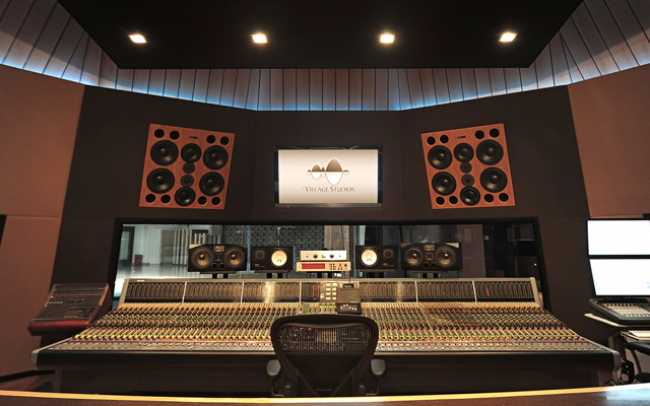
In a corner of Guangzhou not yet transformed by high-rise offices and apartment blocks, lies one of the world’s leading recording studios. Realised by young Chinese singer songwriter, Hins Cheung, Village Studios was born from a desire to create not just a state of the art workplace, but somewhere to facilitate his plans for the future.
‘Because our compound was designed from the ground up, we could incorporate room for significant expansion,’ explains Mr Cheung. ‘I have many plans for the future, including a mastering studio and a professional recording school for training young people.
‘Music production is a work of art. However, if there is a big event in mainland China, they usually hire someone from Hong Kong or Taiwan, which is ridiculous to me as we obviously have enough people and we have lots of recording studios. But we don’t have any iconic recording engineers here, so I decided to create a recording school. Our studios were not only designed to be spacious enough to keep our clients comfortable, but also to accommodate professional recording studio classes.’
Village Studios takes its name from its location: a small area encompassing a few surviving rustic lanes and old buildings, which is a world away from the modern city surrounding it. The facility is built around a peaceful central courtyard with two ancient trees that have been preserved, adding to the timeless feel of the building.
The studio was brought to life by the Walters-Storyk Design Group (WSDG), which has been creating world-class audiovisual production facilities across the world for the past 40 years and was brought in as architectural and acoustic designers. ‘When I was able to build this studio, I wanted it to be one of the best in the world,’ says Mr Cheung. ‘We are especially proud that WSDG created our studio. John Storyk’s first studio assignment was in 1968, for Jimi Hendrix. That studio, Electric Lady in New York City, is still active today, turning out hit records for Beyonce, Bono, Kanye West and other superstars. We hope to achieve the same level of success, and to have an equally impressive client list 40 years from now.
‘Another reason we engaged John Storyk was because of his experience in designing teaching studios for NYU, the Berklee College of Music and other universities. We have made every effort to future-proof our Village.’
‘I was introduced to Hins, and after numerous phone calls, emails and video conferences,’ recalls New York-based company founder John Storyk. ‘We finally met in person and continued what would become a long and winding road through design, construction and commissioning of the studio. Hins’ directive to our group was in fact quite simple: ”Create the best independent audio recording studio in China, and at the same time, design a studio that rock groups as well as a symphony orchestra would feel at home in”.’
On visiting Village Studios, it’s apparent that this brief has been more than adequately fulfilled. The 1,150 sq-m complex has been beautifully designed and crafted to provide a network of calm, yet extremely functional rooms that flow beautifully around the centrally-located, 270 sq-m recording space. This area is flooded with daylight from windows and skylights, and can also be blacked out for film shoots. The control rooms and recording areas radiate around the live room, and there is perfect line of sight between all of them, giving a simultaneous feeling of space and connectivity.
Additionally, the studios conceal a wealth of classic analogue recording equipment, at the same time brimming with ideas for the future. ‘I’ve had a great passion for vintage gear since I was a kid,’ says Mr Cheung. ‘It produces a deeply resonant, dreamy sound which digital equipment may not be able to provide. We take care to preserve the nobility and originality of each instrument, treating each piece with respect for the craftsmanship that went into its making.’
Mr Cheung’s love of good equipment, old and new, was apparent to Mr Storyk right from the beginning. ‘Hins has very clear ideas about equipment and the recording process – a kind of special combination of analogue and digital coherence,’ he says. ‘From the beginning, I was very surprised at his knowledge of systems and the recording process. The final architectural design was a joint effort in programming, one that ultimately created the concept of two distinct, mirror image full sized control room and tracking room complexes, both complete with lounges and isolation booths. On top of this, there is a separate, orchestra-sized rehearsal tracking room that is visible and useable from either of the studios. All of these rooms also had to operate simultaneously, with full range frequency isolation.’
Both sides of the studio complex are a mirror image of each other, including a 72 sq-m control room on each side. Both have a dedicated isolation booth, sound lock and two further recording areas. On one side is a large orchestra lounge which can either overlook the live room or be totally shut off from the studios by means of cleverly positioned walls, windows and blinds, and at the other side are dedicated rooms for maintenance, engineering, microphones and one maintained at 22-degrees centigrade for protecting the vintage reverb equipment it stores.
Control room A is installed with a 15-year-old SSL XL-9000K, imported from the US, Augspurger custom-built monitors and subwoofers, and Barefoot Sound MicroMain 27 three-way active studio monitors. Control room B has an equally impressive desk – a 20-year old Neve VR-72, with custom Munro M6 studio monitors and M118S subwoofers. Both consoles have impressive pedigrees, with Mariah Carey, Celine Dion, Alicia Keys, Aerosmith, BB King, Dr Dre and Carole King among those who have recorded on them over the years. Alongside them are an extensive range of modern day studio staples such as Mac Pro computers running extensive Pro Tools packages complete with a large selection of plug-ins, right through to vintage Studer, Ampex and Sony multi-track tape machines. The racks are stocked with contemporary classic effects units from Universal Audio, Manley, Empirical Labs and Eventide, together with vintage Chandler Curve Bender, Pultec and Cranesong EQs, Lexicon and Eventide reverbs, a Roland Space Echo and Mercury stereo mic amps. There is even an EMT 140 plate reverb to be found in one of the storerooms.
The microphone cupboard is equally well stocked. Alongside standard studio models from Shure, DPA, Neumann, AKG, Beyerdynamic, Schoeps and Sennheiser, who Mr Cheung is an endorsee of, can be found classic Telefunken U47s and an AEA R44C mic.
Village Studios doesn’t end here; there are also a number of equipment storage rooms, fully-equipped maintenance rooms for carrying out repairs and service, an industrial kitchen, a large dining room and a residential wing incorporating six en-suite bedrooms and a master apartment suite. There are also several offices lined with Mr Cheung’s gold discs, tour artwork and multitudes of awards, plus areas earmarked for future projects such as the artist’s intention to offer training and workshops.
The three-year development and construction project saw WSDG carrying out the majority of the design work remotely, utilising high-bandwidth videoconferencing and other shared design and simulation tools.
‘A good example was our design modelling and auralisation of the critical listening and tracking rooms,’ says Mr Storyk. ‘Sound files were transferred back and forth, demonstrating the various recording signatures that would happen as we altered the design of the main tracking room; basically creating a change in the signature RT60 of the room. This was the first time we had done this as extensively and as remotely with a client. In essence, we created the space collaboratively.’
When it came to physical construction of the studio, a team of local contractors with virtually no studio experience was assembled. Although this was a steep learning curve for all involved, the outcome was well worth the effort. ‘I would not characterise this as the easiest construction project we ever participated in,’ recalls Mr Storyk. ‘There were a few speed bumps in the road – they are now only memories! What remains is the finished studio, which ultimately was completed to all of our specifications. During construction we sent WSDG supervisors to China from time to time, particularly for the systems installation portion of the project.’
The studio is now in regular use, both for Mr Cheung’s private projects, including his latest album, Pink Dahlia, and several music videos, and also for outside clients including Sandy Lam, Alan Tam, Sun Nan, Eason Chan, Prudence Liew, George Lam, movie star Zhang Zi Yi, and the Hong Kong Sinfonietta orchestra.
Studio manager Derek Kwan, who is also senior mixing and recording engineer, was recruited last year and clearly loves his work at the studio. A bass player who studied at the Musicians Institute in Los Angeles, Mr Kwan found himself drawn towards the technical side of the recording process. ‘I just love learning about the equipment and what you can do with it; it has become my life,’ he says.
Village Studios embodies a rare quality in the world of commercial facilities. Despite its size, highly professional design and top-of-the-range recording equipment, Village also has a very personal touch, like a supersized project studio. This is largely down to Mr Cheung’s collection of vintage equipment, memorabilia and artwork, and the loving, methodical way it is displayed, bringing a human touch to this beautifully-executed facility.
‘The sheer size of this studio and that it was created successfully in China puts it almost in a league by itself,’ says Mr Storyk. It was an honour to work with Hins – so technically savvy while at the same time working with us and respecting us as only an artist could do. Music, and making sure that it received the highest amount of respect, was always the most important part of the studio design. We should not forget the attention we paid to ensuring that the large tracking room had natural daylight, as well as the fact that virtually all the rooms can see into each other, while being highly isolated environments for simultaneous operation. The fact that so much of the project’s acoustic design was auralised and previewed with real audio files made the design process very special. The studio ultimately is a combination of world-class technology, perfect studio acoustics while at the same time bringing to the recording community an environment that is simply joyful to work in.’
The care and attention that has gone into Village Studios is apparent, and it is an achievement that Mr Cheung, WSDG and everyone else who has helped to realise it should be very proud of. Not just a labour of love and future investment for the artist, it is a huge milestone in the progress of China’s recording industry.