
10 years of Pro Audio Middle East
Published: MEA
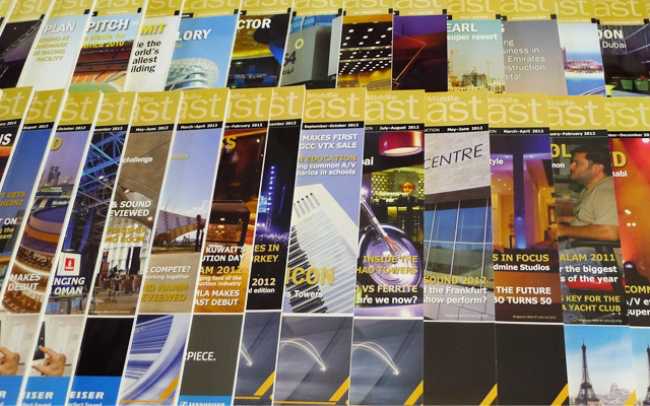
Picture the scene, it’s two years into an entrepreneurial publishing venture. The two founders have found a level of success with their first magazine, but are now looking to take the next step. Initial research has suggested a few territories, but one region stands head and shoulders above the others in terms of potential.
‘We set up Pro Audio Asia in June 2002 concentrating on China and the surrounding countries of South East Asia and India as the prime target for subscriptions. We had an abnormally large number of requests initially from the Middle East, which took us by surprise,’ recalls Blank Canvas Publishing co-founder and GM Richard Lawn. ‘We decided to go along to the first Palme show in Dubai just to see what the market was like and just investigate it further, because we didn’t have any idea what the Middle East was like. With that we saw an emerging Dubai and an emerging UAE. We kept in touch with people out there, saw subscriptions grow, we went to the show the next year which had grown a lot from the initial half-hall template. More and more people wanted to come on board and we realised from the applications we were seeing that we had to get involved.
‘We realised some of the A/V installs, whether they were colleges, hotels, or government were so opulent and with the best, latest equipment that we wanted to be involved with it and have a look at them more,’ continues Mr Lawn. ‘That was when we realised we had to do a dedicated magazine because we couldn’t fit what we wanted in terms of content into Pro Audio Asia. We felt it wasn’t relevant to the Asian readership and the region deserved its own dedicated magazine.’
‘I remember a lot of the early discussions took place at a time when Richard and I shared hotel rooms. That was very much to our favour because it meant we could just kick ideas around, you didn’t have to have a formal meeting,’ adds Tim Goodyer, co-founder of Blank Canvas and currently running Fast and Wide. ‘I remember Richard going into the bathroom and me sitting at the desk and mapping a big piece of this out. And then when he came out of the bathroom, I said “there’s my thinking, you have a go at it now”. It was that kind of very good close working relationship.’
With the idea established and the framework in place, the pair started laying the foundations for what would become the first edition of Pro Audio Middle East. The core ingredient at this early stage was legwork, PR in the region was still in its infancy so the best way to fill the pages of the new magazine was to get out there and spend time on the ground.
‘The setup of the magazine was comparable to PAA in many ways,’ says Mr Lawn. ‘There was a lot of distrust about what we were doing, people wanted to know why we wanted to write about them, why we wanted to write about applications, why was it of interest to us, what we were getting out of it, what they were getting out of it. They couldn’t understand the process of how it helps everybody in terms of sharing information. This was a very hard initial barrier to acceptance,’ he recalls. ‘Once we launched the magazine in July 2004, and companies and individuals saw the results of what we’d been doing, they were very happy to co-operate with us from there on. Since then it’s been the magazine that has been opening doors.’
‘It was a lot of legwork and a lot of physically hard work to launch the magazine and the brand,’ adds Mr Goodyer. ‘In the early days, it was less well-established, so it felt like it was higher risk. With a small team, there are a lot of places to be and no substitute for being seen in the region at trade shows and spending time with people.’
That first issue was very much a statement of intent. The content that was shared with PAA needed to be relevant to readers in the Middle East, and the local stories needed to be sourced from the widest possible geography.
‘The content in the first issue was meant to be a demonstration that we were not doing the lazy thing, we weren’t just staying up in the softest of the territories and taking the route of least resistance,’ explains Mr Goodyer. ‘It was meant to be a demonstration of this being a magazine for people in the region. Part of the reason for the geographical spread was trying to connect the region and define a market.’
Following the publication of that first edition, it was a story of rapid growth for Pro Audio Middle East. The first year saw the pagination increase from 64 pages for the first edition to 88 and perfect bound for July-August 2005. And five editions later it broke the 100 page barrier for the first time. Obviously, this level of growth required an increase in headcount. Sue Gould joined on the advertising side, while Barney Jameson was brought in to add to the editorial team followed by designer Adrian Baker.
‘As the magazines built in visibility, there was too much to do,’ says Mr Goodyer. ‘As the pagination built, so did the revenue and it became possible to increase the staff. That said, it saddened me to give up the editors role, I’d enjoyed it. For all the hard work and everything else, I had enjoyed being the editor of that magazine.’
‘When I first joined Blank Canvas, I wasn’t supposed to be the editor of PAME, I was supposed to be working across all of the magazines in general. I worked across them all for one issue and looking at both publications, I decided that I wanted to be the editor of Pro Audio Middle East,’ recalls Mr Jameson, now editorial director at Blank Canvas. ‘I thought there was huge potential in the magazine. When you have a magazine like PAME, you can experiment more and be a bit bolder. It really worked.’
Having a dedicated editor focused purely on Pro Audio Middle East benefited the publication immensely. It meant that it was possible to spend more time in different geographies around the region and develop the content to tell a bigger story.
‘In the very first days, I just wanted every feature in there to sing, because as a region it deserves it,’ recalls Mr Jameson. ‘I always say the story is the people, they’re the heroes out there. The work that they’re doing, they devote themselves to these projects, they just do so much, and they never really get praised for it. They deserve to be praised for it and they deserve to have their story told. That’s what I tried to do. I tried to stories about the person who spent six months of their life devoted to a project, here’s how they made it happen.’
‘If you compare what we were doing then to what we are doing now, it has changed a lot,’ adds Mr Lawn. ‘Through the evolution of myself and Tim Goodyer leading the editorial through to Barney Jameson then James Ling, each one of those is like a different actor putting on their own signature of how they see the region developing.
‘We’ve always tried to be a world service of news,’ continues Mr Lawn. ‘We’ve been trying to amass all the information from North America, Europe and the rest of the world and provide that to people working in the region who will find it of some use and blend it with information we’re getting from the region. I think that unique blend has helped us if anything. We want to be a spokesperson on behalf of the region and also to deliver content which we feel is applicable, gets read and will get used.’
While everyone involved with the publication over the last decade has left their own unique stamp on the magazine, it’s true to say that Pro Audio Middle East, and its readership has equally made a mark on anyone who has worked at Blank Canvas.
‘Sitting at front of house for Desert Rock when Muse headlined, trusted amongst all that kit it was a special moment,’ recalls Mr Goodyer. ‘I was amongst professional people doing a big professional job and being among them and trusted. That was the magazine and my place in it very comfortably set in that market. That represented what the magazine had achieved through the efforts that Richard and I had put into it.’
‘The great thing about PAME is it’s not like any other pro audio publication in the industry,’ notes Mr Jameson. ‘You hit the ground, you go and do the Diera run, you speak to people, you find leads, it’s proper journalism. You actually go out and find something to write about, you’re not just spoon-fed. It teaches you a new way of dealing with things. I know that I can walk into almost any venue now and I can spot exactly what the challenges were, why they’ve put things in certain places, whether it’s good or not. I learnt all of that from going to the Middle East, listening to people and trying to soak it all up, it made me a better writer.’
Of course, the final words have to go to the man who has been there since the beginning. ‘Ten years seems like a long time, but it isn’t really,’ says Mr Lawn. ‘I’m proudest of getting the magazine actually up and running. It was a hell of a challenge, one that as a small team at the time, we didn’t think we’d be capable of. It was challenging, but we’re proud that we’ve been able to do that, we’re proud of the contacts we’ve made.
‘We’re very fortunate that we’ve been allowed to evolve and survive as much as we have done and develop some wonderful working relationships through a multitude of different people whether they’re distributors, SIs, broadcasters, right down to the manufacturers and the readers,’ concludes Mr Lawn. ‘We love that feedback, we love those interactions, that’s what makes a good media channel tick. When you approach a market, when you represent a market, you have to really engage with everyone from the person who made a piece of equipment to the person that uses it or aspires to use it. That is what we have always tried to do, and that is what we will continue to do.’