
All in the blend
Published: MEA
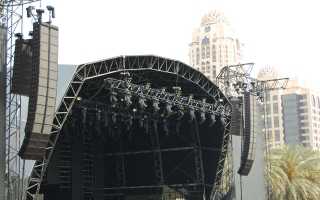
No matter the size, scale or location, music festivals will always provide their own unique set of challenges. Whether that’s sourcing the right gear to meet the various technical riders or rapidly changing the setup between performances, there is always the potential for things to go wrong.
‘Festival work sorts the wheat out from the chaff. It is enjoyable, but it is quite stressful because we are running to a timeline,’ says Delta Sound director of engineering, Al Woods. ‘It’s a great achievement for it to go well and sound good. You know that’s the case when all the engineers leave happy and the punters to come up to you and say how good it sounded.’
This was the aim for Delta when Done Events called it in to supply the audio equipment for Blended. The season-ending two-day festival took place at Dubai’s Media City Amphitheatre. While the venue was a familiar one for Delta, the nature of the festival provided some unique challenges.
Perhaps the biggest technical issue was the volume of wireless equipment demanding space in the frequency spectrum. ‘It was a pretty big setup on stage as far as RF was concerned. On one day we had 47 channels of RF working between one band being on and the next band line checking, so that was very busy,’ recalls Mr Woods. ‘We used two separate systems because of the requirements. We had 16 channels of Sennheiser 2050 IEMs as well as eight channels of Sennheiser G3. Added to this we had over 20 channels of Shure UR4D with either UR1 beltpacks or the handhelds.’
According to Mr Woods, preparation is vital when managing this number of channels, and this is where he credits the work of his colleagues. ‘To cover all this, Mahesh Ramdin scans the site first to see what’s what. The problem with Media City is that it’s very busy during the day with RF because of all the media companies based there and it quietens down at night. This means that sound checks can be a little bit hectic, especially on a Thursday,’ he explains. ‘Mahesh scans the site to obtain frequencies we can use and then does a frequency plot. The RF channels slot into the overall spectrum and it’s just careful management from there. We run everything low power to keep the noise floor down monitoring the systems continuously.’
Away from the RF, the PA system itself was relatively straightforward. Delta’s familiarity and understanding of the challenges presented by Media City provided a good starting point for the system design. ‘The PA we put in here is a system we have used for a few seasons, it works really well, and we pretty much cut and paste it from any gig we do here,’ reasons Mr Woods.
‘Although quite often the grandstands change depending on sales, the VIP section might get deeper or higher,’ he continues. ‘Something that the general public may notice not are the small hot spots of level and frequency build up between areas within the venue. We usually counter this with amplifier shading or putting in FIR filters to decrease these level or frequency discrepancies. Rob Eatock and I have been trying to work on the ultimate angles for the venue so we don’t have to do any correctional work on the PA. We did a little bit of that for Blended, Rob did the Soundvision simulation and it translated seamlessly to the actual PA. Every time we do a show at Media City it gets better and better.’
Having worked on the first edition of Blended in 2014, Delta was familiar with the concept and able to tailor the system design to meet its specific needs. ‘We changed the PA slightly this year. We did 12 L-Acoustics K1 a side and then four K2 underneath instead of the Kara, which was the norm here. Behind these hangs we had the six flown K1 Subs and then 24 SB28 subs in a line on the ground with a small gap in the middle. The ground sub array coverage is smoothed and shaped using an electronic sub arc,’ says Mr Woods. ‘We use LA8 amplifiers and Meyer Sound Galileo processors to help with the system set up. We had to try and keep the audio inside the bowl because there were other stages and activities going on elsewhere on the site, so the side hangs were very small, just two six way hangs of Kara either side.’
In a festival system, console selection can often be one of the more challenging aspects. However, there was definite consensus amongst Blended’s headline artists. ‘An interesting thing was that everybody was happy with a DiGiCo Wave-enabled console, so we supplied two Waves-enabled SD5s. Everyone was running at 96kHz and using the waves packages it was great to see and hear the results,’ says Mr Woods. ‘The two SD5s were flip-flop consoles and we had two Avid Venue Profiles on stage in partnership with the SD5s. The only exception to this was Robin Thicke who wanted an Avid Venue Profile for FOH.’
The SD5s were not the only DiGiCo consoles at FOH. As part of his standard setup, Mr Woods also includes an SD11 for infrastructure mixing. ‘I mix the comms and the shout system at front of house, so the lads on stage don’t have to worry about it,’ he explains. ‘We had quite a comprehensive shout setup with IEMs, headset mics and shout boxes on three different circuits. This was all matrixed through the SD11. The PA inputs go directly into the Galileo at front of house, so they don’t hit any other console. I also mix all the compares or warm up music on the SD11.’
Away from the main stage, Delta also took responsibility for the Pizza Express Jazz Garden. With only a small setup required for this space, the rental house took the opportunity to give one of its junior engineers more experience. ‘That was a much smaller stage and had a ground-stacked dV-Dosc system with some SB28s,’ says Mr Woods. ‘We brought in one of our rising stars, Rayno Spies, to mix it. We gave him an analogue console and some outboard gear and he had a great time and it sounded brilliant.’
Of course, the technical setup is only as good as the team using it, and this is where Mr Woods reserves special praise. ‘We had Rob Eatock, Arif Khan, Mahesh Ramdin and Phil Down on stage and as always they were great. The change overs were really slick, the patch was good. I spent quite a few weeks beforehand doing paperwork preparation for Blended, receiving riders working out how many inputs we were going to need. Then producing an input and output template for each act. The lads on stage stuck by it and it worked.’
Reflecting on the festival itself, Mr Woods believes it was the right way for Delta to finish its live music work for the summer. ‘Blended was a good way to end the live season. We’ve done really well all season, we haven’t had a disastrous show or a show with a glitch to mention,’ he concludes. When you’ve spent the time to make sure visiting engineers get what they want including a good sounding system, and then it sounds great is always a bonus for me. All the engineers left happy so a double bonus.’