
Gearhouse celebrates success of internship programme
Published: MEA
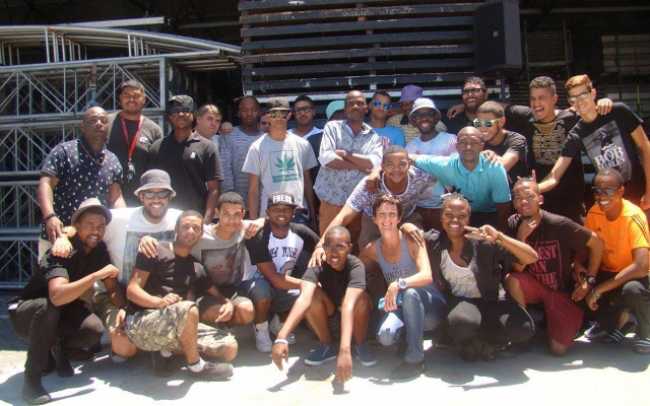
SOUTH AFRICA: Now in its 13th year of operation, the Gearhouse Kentse Mpahlwa Academy (GKMA) is celebrating its status as an effective contributor to raising the skills standards within the South African live events industry.
The free-of-charge, one year internship run by Gearhouse Group South Africa covers A/V, lighting, structures, rigging and power, along with the auxiliary working at height, firefighting, first aid and safety standards training. The programme runs countrywide for 10 months of the year and students have the option of a follow-up second year specialisation programme as well.
The last couple of years have seen the GKMA initiative maturing into a self-perpetuating cycle. For training manager, Josef van Schalkwyk, this is the realisation of a long term goal for the academy. ‘We are finally seeing the results of our team effort to establish and run the training facilities, to create industry specific SAQA-accredited course materials, to provide learners with a nominal “salary” so that they can study full time and equipping 45 junior technicians to enter the Technical Production Services sector each year,’ he explained. ‘There are success stories across the board, particularly in the percentage of black (87 per cent) and female (12 per cent) technicians last year but our Cape Town Branch has been the benchmark in terms of the number of students remaining within the industry and the branch itself and carrying out training of newcomers themselves.’
The retention rate of graduates in the early stages of the Cape Town training facility in 2007 was not what had been hoped for. In 2012 to fast-track skills development, the facility started bringing back learners from previous years to join a second year specialisation programme. As a result, the number of graduates making their careers in the live event industry increased dramatically. Forty-seven of the Cape Town training centre’s 62 graduates since that time have remained within the industry and 40 of those have stayed on to work at Gearhouse itself.
Subsequent on-the-job training within the Gearhouse Group’s various companies has resulted in many of those graduates now fulfilling senior roles within the organisation. ‘The camaraderie between current and ex-students has built a whole new level of teamwork and skills transfer here,’ said Cape Town GKMA training facilitator, Lisa Smit. ‘Our students have had to overcome personal battles, cultural and personal differences to work together effectively and in doing so have learnt to respect themselves and each other. In an industry governed by stringent deadlines and extreme conditions, an integrated team is imperative to the success of the event.
‘On any one event site we work on in Cape Town now, around 95 per cent of the build crew are learnership graduates,’ continues Ms Smit. ‘Those who are not, are generally designers or management. We have some highly talented up and coming designers and project managers on their way. Two of our graduates are already designing small events. We are headed for 100 per cent saturation point.’
Equally important to the programme is the opportunities it provides. ‘One of our learners had struggled for a long time to find employment and had absolutely no knowledge of our industry when he arrived at the academy. The year that he graduated, I felt so privileged to have witnessed this young man take the opportunity and make something of it, that I literally wept with joy,’ recalled Ms Smit. ‘Today he manages the lighting team on-site and works alongside the LX designers during set-up. This is the kind of experience that keeps me going. My job satisfaction comes from seeing their pride in what they have achieved.’
Ms Smit facilitates the Technical Production Services course in Cape Town with the help of the branch’s stores, maintenance security supervisor, Irafaan Brock. Other courses are run by training facilitators, Neermala Rajagopal in Durban, and national training manager, Josef van Schalkwyk in Johannesburg producing around 35 graduates respectively per year.