
Grand scale
Published: MEA
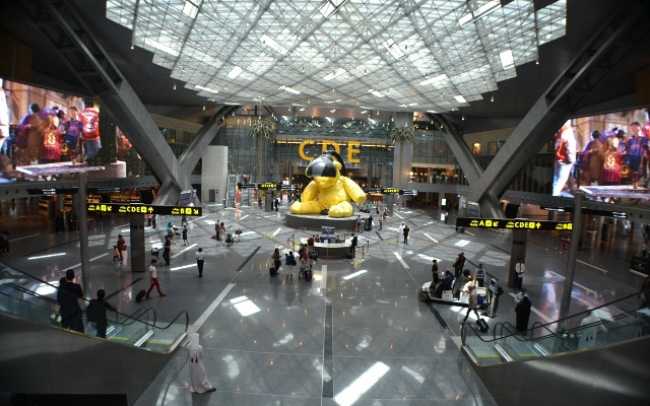
Qatar’s new state-of-the-art gateway to the rest of the world, Hamad International Airport, has opened complete with a large Renkus-Heinz system. James Ling reports
In terms of project size, Doha’s new Hamad International Airport is on the grandest of scales. With its two runways (both amongst the longest in the world) and state-of-the-art passenger and cargo complexes, the airport spans 29 sq-km – equivalent to a third of the area covered by Doha. Making this feat even more impressive, around 60 per cent of this area has been reclaimed from the Arabian Gulf, making it one of the largest greenfield airport projects in the world.
The numbers behind the new airport are equally impressive. The passenger terminal will serve an initial 30 million passengers a year, growing to a projected 50 million within its first few years and has the capacity to handle 8,700 passengers per hour. In dual runway operation, it can handle 90 aircraft per hour, adding up to 360,000 per year. As for cargo, the airport currently has a capacity of 1.4 million tonnes per year (although this is set to increase) and it processes 5,700 shipments at any one time.
As would be expected with a project of this stature, the technology for every part of the airport has been built to the highest standard. Amongst its list of advanced solutions, Hamad International Airport features an RFID baggage handling system to pinpoint the location of bags at every stage of the process, it has cutting-edge air traffic control systems for greater safety and efficiency, and a radar-based debris detection system enabling 24-hour runway scanning.
Joining this list of impressive systems is the Renkus-Heinz PA. Covering everywhere from the check-in desks to the departure gates and baggage reclaim to the arrivals lounge, 245 of the manufacturer’s Iconyx digitally steerable line array loudspeaker systems have been installed around the airport. The main element of the system is the 208 IC8-R speakers, but these have been joined by 30 IC16-R, plus five IC24-R while a pair of IC32-R complete the solution. The whole solution has been networked, and each of the 245 speakers is individually addressable to ensure that the operator has the highest level of control.
Despite the size of this install and the number of speakers put to use, unless you are specifically looking for them, you will be hard pressed to see a single cabinet. ‘All the loudspeakers are hidden. They have all been flush mounted somewhere, or they have been integrated into custom designed stainless steel pillars,’ says Norbert Bau, the manufacturer’s Middle East sales manager. ‘It’s an architecturally stunning facility and the best Iconyx installation I’ve ever seen. From the interior integration point of view, I have seen nothing that can beat this installation.’
This is quite a claim from Mr Bau, and he is quick to point to the contractor and sub-contractor that put in so much effort as the reasons for the success of the project. ‘The quality of workmanship for the whole project has been really impressive. The low voltage contractor was a local company called Consolidated Engineering Systems Co (CESCO). They subcontracted H. Robert Guild Associates, Inc (HRGA). While the design was made by Acoustic Design Ahnert (ADA Gulf),’ he explains. ‘The entire installation has been done by the local contractor CESCO. They are a low-current contractor, they usually do structured cabling, CCTV systems, and access control systems. For them it has been the first time doing a demanding sound system, which is why they subcontracted Robert Guild of HRGA.’ Obviously, having such a high-profile installation as a first demanding sound system would be a challenge for any company. Fortunately for CESCO it was able to call on the experience of HRGA plus the level of detailed planning that all integrators dream of.
‘The project was set up in a way that the contractor was able to afford a very dedicated design and installation team,’ explains Mr Bau. ‘It meant that for every single Iconyx, there was a drawing covering how to install it, where the cables come from and where to install the connection box – behind the column or by the side of it.
‘All of these details were seriously considered column by column and we are talking about hundreds of speakers,’ continues the Middle East sales manager. ‘These were all approved and submitted to the architects. The contractor has been very particular with every single detail, nothing was possible without approval.’
What makes this more impressive is that through the work of every company involved, this has been one of the very rare occasions where acoustic design has won out over interior design. ‘The architects were convinced that if the acoustic design said a speaker had to be positioned in a certain place in order to have good intelligibility, then they would find a way to put it there,’ reveals Mr Bau. ‘Usually it is the opposite so this was completely different for this project. It is why across the airport you can find a lot of these stainless steel columns, most of them housing just Iconyx but some of them also house some of the CCTV equipment as well.’
While winning over the architect has been an important part of the project, Mr Bau is also keen to highlight the variety of work handled by CESCO. ‘It has been and it is a huge project. With HRGA they have installed a massive IED announcement control system and thousands of Penton ceiling speakers for the voice alarm. There is a mix of 100V line, analogue line and control facilities. So it is not an easy task to oversee something of this scale and make sure every single detail of every system is being considered carefully and executed in the right manner. There are several disciplines involved in executing such a sound system.’
As would be expected with any project of this scale, there have been a number of challenges and issues that all parties have needed to solve. However, despite this, the result is one that the customer is impressed with and Mr Bau believes people should take the opportunity to experience it for themselves.
‘It’s a good working system from the performance point of view. This is because a couple of important things took place,’ explains the Middle East sales manager. ‘First, the design of the sound system was seriously considered when designing the airport. Second, ADA Gulf convinced the architect to apply acoustic treatment so the acoustic conditions are very good – it sounds very dry. It has been done in a proper way, the conditions to end up with proper intelligibility were applied in a good way which is why it has ended up sounding good.
‘The testing and commissioning has been done by HRGA, backed up by our team of application engineers, whenever needed,’ continues Mr Bau. ‘HRGA passed all relevant tests and got all approvals to certify a sound system has been installed that meets the consultant’s and architect’s expectations. Renkus-Heinz is very proud to be part of this exciting project.’
Having now opened its doors to passengers, Hamad International Airport is well on the way to becoming the international hub that it was designed to be. It has the capacity that Doha has been desperate for and should be able to meet the needs of Qatar Airways well into the future. Equally, it has a sound system that will clearly and intelligibly serve the millions of expected passengers long into the future. As Mr Bau concludes, ‘at the end of the day, it has become quite an impressive system for a very impressive airport’.
www.ada-gulf.com
www.cesco.com.qa
www.dohahamadairport.com
www.hrga-av.com
www.renkus-heinz.com