
Iconyx remains ‘invisible’ at Heydar Aliyev Center
Published: MEA
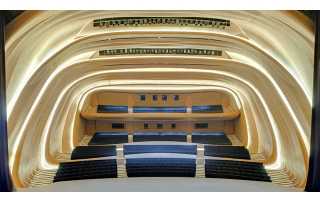
AZERBAIJAN: Turkey-based A Group was recently awarded the contract to supply and install the audio, lighting and visual design into the Heydar Aliyev Center’s 980-seat auditorium. The 100,000sq-m arts complex is an architectural icon in Baku, designed by London-based Iraqi-British architect Zaha Hadid. When selecting an audio solution for the main auditorium/conference hall, Mr Hadid specified that all technology should be ‘invisible’ to the audience.
A Group addressed the issue of 'invisibility' by recommending Renkus-Heinz digitally beam steerable IC Live arrays to focus tight beams of sound from hidden locations precisely into specific audience areas, with the highest possible level of audio fidelity for both speech and music.
A Group supplied the complete technical design and fit-out including a mechanical stage system and orchestra pit, with a specially designed balustrade, and acoustic towers in front of the loudspeakers.
‘We had originally planned to install the speakers directly onto the walls,’ commented A Group’s Suat Durkan, who led the 20-strong team. ‘However the architect did not want to see any technical products. So we designed a system of wooden slots with acoustic cloth, providing 100 per cent audio transmission.’
The towers neatly conceal eight Renkus-Heinz IC Live ICL-FR digitally steerable column arrays, each equipped with multi-channel class D digital amplifiers with integral DSP engines controlling every array element with programmable precision, and equipped with Rhaon, the Renkus-Heinz audio operations network.
Each ICL-FR delivers 105dB SPL, with flat output response from 80Hz to 20kHz. Extending the low frequency range are four BP15-2R Rhaon -enabled self-powered subwoofers and four CF1215R self-powered Rhaon-enabled stage monitors.
‘This centre is of great cultural and architectural significance to the arts in Baku and we are very proud to have made a major contribution to the performance technologies that help make it so special,’ said Mr Durkan. ‘We provided high quality, high intelligibility sound from sources that cannot be seen by the audience - exactly as the architects and designers required.’