
Reference standard
Published: MEA
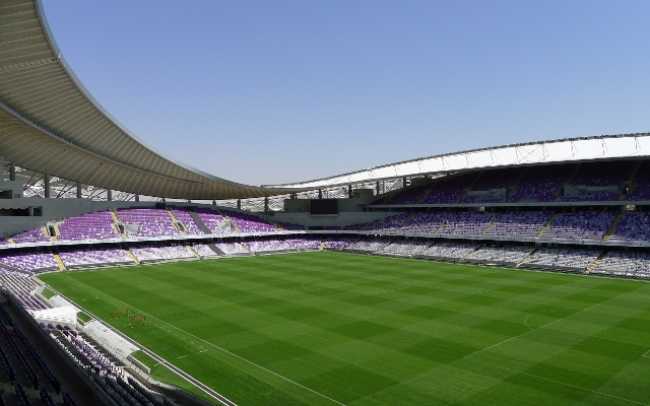
The new home of Al Ain FC has generated a lot of interest as the importance of the Middle East stadium market gathers pace. James Ling tours the latest local reference project
Stadium visits have become something of a habit for Pro Audio Middle East. From South Africa to Turkey, and Qatar to the UAE, we have toured some of the best new football stadia in the region. While these have always been an interesting use of pro audio and PA/VA technology, their importance in the region has grown since it was announced that Qatar would host the 2022 FIFA World Cup.
Since then, every major manufacturer, distributor and integrator has looked to highlight the work it can do in this area. The potential for future business means that huge resources are thrown at every new stadium project. As such, some of the best equipped modern facilities can now be found in the Middle East. The latest addition to this list is the 25,000-seat Hazza Bin Zayed Stadium, the new home of Al Ain FC.
Approaching the stadium, Pro Audio Middle East is immediately grabbed by its unique design. The flowing, wave-like lines of the roof and the angular panels which are illuminated by colour-changing LEDs at night are in stark contrast to the architecture in the rest of the oasis town. The striking design continues inside. The purple seats contrast boldly with the white walls and roofline to mirror the home team’s colours. This is a stadium which demands attention.
As would be expected when the visual aspect of the venue is so high on the priority list, the speaker system covering the stadium bowl is well hidden. However, this does not mean it received little attention. Getting the sound right inside the Hazza Bin Zayed Stadium was a major priority, and the responsibility for this fell to the UAE office of JBK Controls International.
‘As JBK we became involved as the ELV subcontractor,’ says Ebrahim Mohamed Rafiq, manager – technical at JBK Controls International. ‘We did around 10 to 12 systems including the pro audio system and the PA/VA. Apart from CCTV and access, all the ELV systems were done by us. It was a big job.’
On the audio side, JBK’s work begins in the public areas surrounding the ground with the PA/VA system. TOA public address speakers are spread around the ground in key locations and continue up inside the stadium to aid the evacuation in the event of an emergency. ‘We make announcements using the TOA public address speakers. These are only used for the public spaces, not the stadium bowl,’ explains Mr Rafiq. ‘We have two rack rooms for the PA/VA. The PA/VA rack features the systems manager, the power amplifiers, and the back-up amplifiers all from TOA.’
Control and monitoring for this system is taken care of from the basement control room for the majority of the time. Here all the security and safety systems are monitored around the clock by a dedicated team of security personnel. However, on match days the control moves upstairs to the fifth floor event control room, a space Mr Rafiq describes as ‘the heart of the stadium’.
It is easy to see why. The large, open space features control positions for every major system from the IPTV and giant LED screen, to CCTV and of course the main bowl PA. Here, sat in their own space separate from the other controllers, the sound engineer has one of the best views in the house. The position features both PA/VA capabilities and the control of the main audio system. A TOA paging and fire system for the PA/VA sits next to a Dynacord CMS 2200-3 22-channel mixing console which manages the bowl system. ‘You can use a mic for announcements and during a live match you can broadcast from this position,’ says Mr Rafiq. ‘Also, if there are adverts on the giant screen, they can play the audio through the main PA. It is a completely integrated system.’
The bowl system itself again calls on equipment from Dynacord, but also that of fellow Bosch brand Electro-Voice. In each of the four rack rooms sit Dynacord DSA 8410 amplifiers along with the manufacturer’s P64 master DSP. These power and process Electro-Voice EVF and EVH enclosures which have been installed around the roof line.
‘The speakers for the pro audio system are in clusters,’ explains Mr Rafiq. ‘There are 32 clusters of speakers which cover the entire bowl area. The sound quality is excellent, I have no question about it. In terms of the PA, they have divided the stadium into four quadrants. So even if one zone fails, there is still coverage from other zones.’
This portion of the system was designed by Dubai-based Dynacord distributor Prosonic in coordination with the manufacturer. ‘We were involved in the design side, with support from the EVI team from Tony Sawyer and Oliver Sahm. We used EASE simulations to build the best sounding system,’ recalls Prosonic manading director Amir Bagheri. ‘It changed a lot because of the roof structure. There was lots of re-do work for the design.’
In addition to these 32 clusters, there is a ring of Electro-Voice Evid cabinets which act as fill for areas which are not covered by the main system. ‘The main speakers are on the edge of the roof and those few rows at the back under the second tier aren’t covered by them,’ explains Mr Bagheri. ‘We used the small Evid speakers to cover all the areas. They go around the whole bottom ring where we were not able to focus from the roof, but we take care of most areas from the roof.’
‘We never faced any problem on the design issue in terms of the SPL required,’ adds Mr Rafiq. ‘The sound level is even all the way around and matches the level we proposed.’
The key point for Mr Rafiq though is how the system has performed in during the events which have taken place at the stadium. ‘It all sounds good. My main appreciation is that there has been no complaints during matches which shows my system is working correctly,’ he explains. ‘If the system doesn’t work at the right time, then there would be a big issue.’
As with all major projects, this installation came with its own set of technical challenges. The one that most sticks out for Mr Rafiq came with the giant LED screen. ‘The giant screen was one of the challenges that we faced. It was the first system that we made ready in the stadium. It needed to be completed before a practise match and people were working on it for four days day and night to get it ready,’ he recalls. The main issue came from its positioning and that it would be exposed to the full force of the sun. ‘The screen is sealed and weatherproof. Inside there is A/C to maintain 21-degrees Celsius so the components shouldn’t overheat.’
At two years of site time, this has been a very long project for JBK and Mr Rafiq, but one he is rightly proud of. ‘We are happy with the end result,’ he reflects. ‘It was a bit of a struggle because of the time constraint, but every project is like that. When the target crunch comes from the client side, down the line everyone has to take the hit,’ reasons Mr Rafiq. ‘We have gone through a long process for the handover. We had a tough time but thanks to the work of my team, we made it happen.’
This satisfaction is shared by the other companies involved with the stadium install, and the standards achieved have made it a prime reference site for all involved. ‘There are a number of projects going on at the moment. A lot of investments are currently made into sport venues, indoor or outdoor stadia and sport halls,’ says Klaus Seitz, Middle East and Africa director of sales ProSound/CCS for Bosch Communications Systems. ‘The Hazza Bin Zayed Stadium gives another important reference to all parties involved, from the consultant to the end user. It confirms again the capabilities of Dynacord, Electro-Voice and Bosch.’
‘It’s a good reference for the region,’ agrees Mr Bagheri. ‘There are more stadia coming in the region and it’s nice to have a good reference. We try to keep this, maintain this and make sure it is a good reference point, not only for ourselves but for EVI. We hope to use it to help generate future business.’
As Pro Audio Middle East leaves the Hazza Bin Zayed Stadium, we can’t help but feel that this focus on sporting reference projects has benefitted more than just the companies involved. As every architect, builder, systems integrator and manufacturer tries to prove they should be involved when the World Cup projects are tendered, a range of beautifully designed and built, high-tech stadia have sprung up across the region. Their construction will undoubtedly lead to many companies securing some lucrative business in the future. But the real winners from this current situation are the teams with top of the line new facilities and the supporters who fill them every week.
www.jbkcontrols.com
www.prosonic.ae
www.dynacord.com
www.electrovoice.com
www.toa.jp