
Renkus-Heinz powers the gigantic Astana State Auditorium
Published: MEA
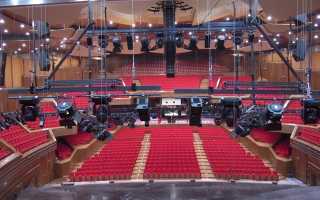
KAZAKHSTAN: In the Kazakhstan capital of Astana, one of the city’s most impressive new structures has recently received a new Renkus-Heinz sound system. The 3,500-seat Astana State Auditorium – one of the largest of its kind in the world – has been fitted with the line array system by A&T Media.
The exterior of the auditorium was designed by renowned architects Studio Nicoletti, and has been labelled the ‘Flower of the Steppe’ due to its petal-like walls. Inside the building, in addition to the auditorium, there are also restaurants, shops, exhibition halls and two cinemas. The auditorium's interior is as dramatic as the building itself, with unique fan shaped wood ceiling panels used to create flexible acoustics able to accommodate a wide variety of events.
‘The most important consideration was to achieve a consistent sound coverage across the entire auditorium,’ said Alessandro Baroni of A&T Media. ‘It's a very unique design, with multiple levels of seating and an upper balcony that wraps around behind the stage area. The sound system needed to be flexible to adapt to a wide range of performance materials and a wide range of seating configurations.’
The system comprises a main array of 16 Renkus-Heinz PN102LR line array loudspeakers, along with a secondary array of five PN102LR cabinets to cover the upper balcony behind the stage. A centre cluster of nine PN212 subwoofers provide low frequency reinforcement, and four ST9 cabinets cover lateral fill. The very front rows are covered by seven SGGX42 boxes mounted on the lip of the stage. For increased versatility, the main array can be hoisted up into the ceiling when not in use, and a second complete system comprising 12 IC Live ICL-R digitally steered column arrays on custom brackets can be deployed.
‘The Renkus-Heinz systems were a good choice for this project, because the beam steering and built in DSP enabled us to configure the system to cover all the seating, at multiple levels and locations,’ added Mr Baroni.
A pair of Yamaha M7CL-48 mixing consoles were installed at FOH and monitor positions and four Symetrix Solus 8 units provide system DSP. Everything is connected via a network of Ethersound, Rhaon, and CobraNet.
In addition to the sound equipment, a dual stack of Christie Roadie HD+30K DLP projectors were installed in the auditorium.
‘We ran into several challenges,’ noted Mr Baroni. ‘We had too much heat buildup in the rack with two projectors, so we had to work out how to insulate the rack to keep it cool and keep the fan noise down. And we had to design a mounting system that was steady enough to hold the machines so the two images would stay perfectly aligned, pixel-by-pixel, to not lose image quality and definition.’
A total of four Sony BRC 3000 HD video cameras cover the room, with a Panasonic AV-hs400 video console at the helm. There's also an interpretation system able to provide subtitles in eight different languages.
Mr Baroni reports that there were a number of challenges for the team to overcome: ‘Of course, it was a challenge to be working in Astana, 6,000km away from our headquarters in Italy. And the winter climate was very severe. With such a big project, the scheduling and coordinating of different phases and crews is always a bit difficult. But we worked it all out in the end, and the result is nothing short of fantastic.’
www.renkus-heinz.com