
Right first time
Published: MEA
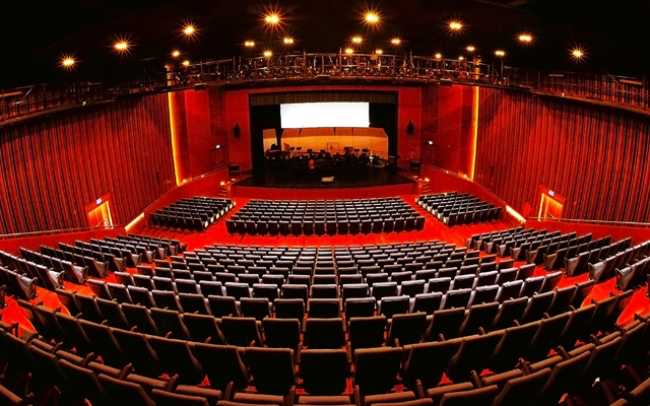
When the American School of Dubai moved to its new campus it had ‘one shot’ to get the facilities right. James Ling looks at how this was done at its state-of-the-art multi-purpose performance space.
The American School of Dubai’s new campus was developed with one principle in mind – getting it right first time. The school made the commitment and investment to move to a larger site that could offer its students better facilities, so it was essential that each part of the new site would deliver the desired results. Critically, this meant each area had to not only be technologically up to date, it also had to provide a suitable teaching environment.
Some of the real beneficiaries of this move have been the drama and music departments. The new campus has provided the departments with a 650-seat main auditorium, described as being ‘as well equipped as any other theatre in the UAE’, as well as a second smaller theatre and acoustically treated rehearsal and teaching rooms.
The installation for this part of the campus was handled by Dubai-based systems integrator Omnix with Eddie Hirad acting as project manager, while the design was by local consultancy Innovation. Around the facility Omnix has fitted a Tannoy PA consisting of ceiling and wall-mounted speakers to relay messages and BGM as well as tie in with the fire alarm system. The company has also equipped numerous classrooms and rehearsal spaces with acoustic panelling and drapes to ensure they are sonically optimised for both uses.
While the attention to detail in these areas is impressive, the highlight of the project has to be the main theatre. Here, a combination of brands have been put to use to create a multi-purpose venue that can change its design and acoustics to accommodate acoustic and amplified music as well as theatrical performances and lectures.
‘They moved from another premises in Dubai where they had very limited facilities and they saw this as their opportunity to get what they wanted,’ says Innovation’s Jasper Whitaker. ‘Normally when you think of a school your immediate concern is budget, and you tend to underplay what you might put in this kind of venue. When I did that they said, “we’ll tell you what we want it to do, this is our one shot at getting it right. You come back to us with a proposal of the way it should be done as a multi-purpose theatrical space that can be used for drama and music, and then we’ll work out whether the budget is available”,’ he recalls. ‘There was never any quibble about the budget. With the campus being such a big project with a large overall budget, this only took a very small part of it.’
The resulting theatre system is based around Community Professional iBox Series speakers. ‘We have a central cluster, left and right, we’ve got delays on the second bridge and then some subs at low-level,’ explains Mr Whitaker. ‘The subs are not ideally located, they couldn’t be incorporated and recessed into the proscenium arch because there is a sheer wall, and we couldn’t put them in the stage front because that is an orchestra pit. We moulded the design of the decoration to assist in the concealment of them.’
Power comes from Crown XTi6000 and XTi4000 amps, while DSP is courtesy of BSS Blu100 processors. A mic package from Shure including wireless and general purpose options plus AKG hanging, boundary and lectern units are also in use. Other equipment from Switchcraft, Yamaha, Tascam, Cloud, Avid, QSC, AMX, Tannoy and Extron completes the installation in the main auditorium.
The consultant describes the audio system as ‘very analogue on the ground – there’s no CobraNet coming from the stage’. The audio is all through XLRs in various facility panels, but Cat-6 cables and fibre have also been run to all the patch panels for future use and provide the option for HD video connections. ‘There’s a lot of connectivity, everything goes through patchbays so it’s all fully adjustable, flexible in terms of what they want to use.’
For simple setups such as a lecture, the system also offers a level of automation that means an operator is not required. ‘There’s a dedicated facility panel which connects to an automatic mic mixer. So if they want to do a real simple microphone on lectern PC presentation on the screen, they can do it themselves without the need of an operator,’ explains Mr Whitaker. ‘They can do it all off the touch panel. There are presets for the lighting, they can control the screen up and down, for the audio there is level control and source select.’
The use for presentations was also considered when it came to visual setup. ‘Video-wise it is a rear projection system. Because this can also be used for lectures, they wanted an opportunity where someone could walk in front of it or they could have a top table in front of the screen without causing a shadow on it,’ explains Mr Whitaker. ‘We’re using a short-throw lens and they were okay with the amount of space they were going to be left with to the front bearing in mind what they would normally use that kind of system for.’
For the scenery, 18 48mm steel tube bars are operated by a manual double-purchase counterweight system. Any payload attached to the bar is counterweighted by adding weights equivalent to twice the mass of the payload to the cradle.
The venue’s lighting system includes an ETC Ion lighting console with manual control wing and wireless DMX interface, Light Processor Dimension dimmers, Socapex and DMX Patch Panels, DTS XR9 moving heads, 1KW and 2KW LDR generic luminaires and Internally wired lighting bars.
While this hall formed the main showpiece of the installation, further work was required around the complex. Behind the main auditorium is an area that doubles as both a green room and secondary performance space – the Black Box Theatre. ‘They wanted a totally flexible space here, they wanted to run it anyway they can do. There are four potential stage locations all with connectivity points through patchbays,’ says Mr Whitaker. ‘Obviously you have projection in here too. The projector point is in the middle on the basis that you will only need one as the projector is almost always in the same location.’
Due to its dual role, the theatre also contains relay speakers. ‘You have show relay and paging from the control room,’ says the consultant. ‘There’s a comms system in the main theatre in high-level and low-level locations and on the lighting bars. There’s show relay to this area, the makeup rooms, the stores and the workshop.’
The Tannoy sound system in the theatre has been designed not only to provide multiple different potential stage areas, but also to be fully portable for any outdoor events the school puts on. ‘All the sound and lighting systems in here are built into portable racks. So if they want to take it out on the road or do something outside, then provided they have the power, they can do that,’ explains Mr Whitaker. ‘Likewise they can use the monitors for the main theatre as additional speakers where ever they want to use them.’
While the audio equipment for both theatres, along with the other electronic systems, the stage rigging, seating, acoustics, lighting and architectural lighting was specified by Innovation, the school was also involved in the design process. ‘They had quite a lot of input with things they wanted it to do, this has to be a teaching environment as well as an environment for putting on events,’ says Mr Whitaker. ‘Outside of the rigging equipment, where there would be a safety issue with students using it, it’s pretty much a hands-on environment. For example, they wanted a digital mixing console, it’s an Avid Venue SC48, which they have really enjoyed using.
‘I had several meetings with them and talked about what they wanted to do. Obviously it is the usual problem of trying to provide something that will fit everybody’s needs. I think between Omnix, my involvement and the school’s input, we’ve managed to do that pretty successfully.’
It has been a long project where the consultant’s role has gradually increased to one essentially of project manager for the construction of the site. ‘I enjoyed working on it. You have clients with high expectations and high hopes and it’s their one shot to get it right. They were determined not to get it wrong and they’re very happy with the result,’ says Mr Whitaker. ‘From my point of view it’s a wide-ranging project. It’s a great one to be involved with. It was great to work with Omnix as a contractor, Eddie did a brilliant job.’
However, the most important thing for Mr Whitaker has been the response the new facility has received from the students. ‘To know that the kids enjoy using it, that they do get involved with it, that’s the best part.’