
Sennheiser and Rycote enable Namibian recordings
Published: MEA
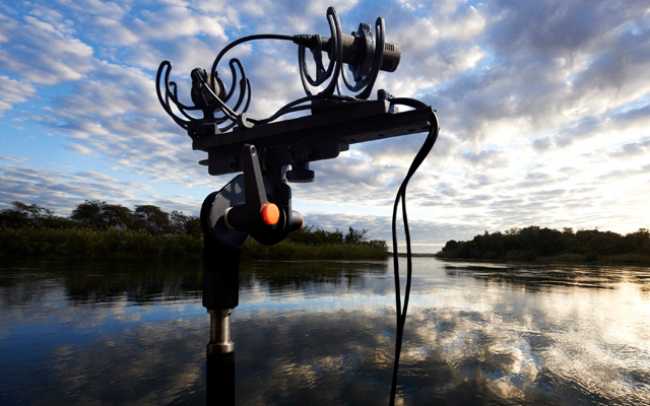
NAMIBIA: Journalist and author Sabine Kämper used a stereo pair of Sennheiser MKH 8040 cardioid microphones and a matching windshield prototype from Rycote as she travelled through Namibia to record ethnic choirs and the sounds of nature. The result of her 9,000km trip: Chorus and Cuisine, a mixture of travel guide, recipe book and music CD, has just been published.
Sabine Kämper and her partner Detlef Overmann visited 18 lodges to record the staff choirs, collect recipes and photograph the dishes. ‘It was clear to me, of course, that I would have to do a lot of improvising when it came to the audio recordings – we could expect to be recording in all different kinds of rooms, from libraries to laundries. For that reason, we needed microphones that guaranteed good recordings whatever the situation, and so I turned to Sennheiser’s experts for help,’ said Ms Kämper. They recommended that she used MKH 8040s.
‘Most of the time, we somehow managed to squeeze the choir into our lodge room or we were able to record in the kitchen. Once, the lodge manager even let us use his living room,’ Ms Kämper recalled. ‘We used an ORTF arrangement for the recordings and fed the sound from the pair of microphones directly into a computer via a small Mbox2 interface. This lightweight and compact audio system provided us with excellent recordings. After the rough cut, I asked the audio engineer what he had done to the recordings to make them sound so perfectly “rounded”, and he said: “Not much. I only put the songs in the order you wanted”.’
Sabine Kämper and Detlef Overmann also used their journey through Namibia to make recordings of typical sounds of the country, which Namibian artists could then use as a basis and background for music compositions. ‘For the atmospheric sounds, for example, I thought of the barking gecko in the desert, the dawn chorus of birds and the sound of antelopes at a waterhole. I wanted to record village sounds or simply the rushing of the Atlantic waves,’ recalled Ms Kämper.
A major challenge in all of these recordings was wind noise. The author also worried about the microphones being constantly exposed to fine sand dust. ‘The Rycote windshield prototype was just what I needed, and the equipment turned out to be extremely sturdy. I was able to record really wonderful natural background sounds, and the production with the artists is scheduled to begin in 2013,’ said Ms Kämper.
‘The microphones were simply fantastic. On the very first recordings in the bush in the Kalahari, I always noticed a kind of buzzing and whizzing sound that I couldn’t explain. The interface was OK, the headphones were fine, the microphones were working perfectly, and there was nothing wrong with my ears. In the end, I found out that I had recorded the wing beats of some weaver birds on a tree some distance away.’