
Tried and tested
Published: MEA
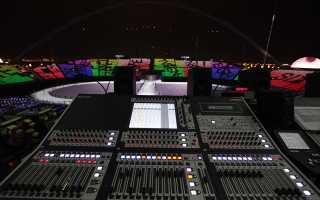
Designing the audio setup for the Arab Games in a short space of time proved to be easier than anticipated for Auditoria, as Alice Gustafson discovers
For the first time in history, in December 2011 the Arab Games made its way to a Gulf state. More specifically, the multi-sport event was held at the Khalifa International Stadium in Doha, Qatar. A venue that is no stranger to hosting such large-scale tournaments, the stadium can count the 2004 Gulf Cup of Nations, the 2011 Asian Cup Final and 2011 Asian Cup amongst its portfolio of past events.
With such prestigious international competitions always come opening ceremonies, which are typically nothing less than spectacular. Used to the familiar sight of a combination of phenomenal firework displays, mass-performances, pyrotechnics, projections and music, the expectation of the modern audience is now a high one. As such, the job of planning, synchronising and executing such a tight operation always falls to highly experienced companies. Enter David Atkins Enterprises (DAE), which was asked to conceive, create and produce the opening ceremony for the 15-day tournament. Having done just that for the 2006 Asian Games in the very same stadium, the main contractor had already proved that it was more than capable of the job at hand.
This time, however, the company wasn’t officially awarded the contract until approximately four months before the event was scheduled to begin, so time was of the essence to pull the ceremony together. It came in handy then, that DAE had worked with an experienced audio consulting company for the Asian Games, and even more conveniently, that they had worked together before in that very venue. Once DAE had been given enough of an indication that it would be managing the ceremony, the company immediately approached Auditoria’s principal consultant Scott Willsallen – who worked under the late Bruce Jackson as audio designer for the 2006 Asian Games – to design and direct the audio. Following this, Norwest Productions (which also worked on the 2006 ceremony) was awarded the contract to provide the audio.
‘As it was the same venue as the Asian Games with very similar staging, the loudspeaker system design was based around the one that I put together for 2006 ¬– which was very successful,’ explains Mr Willsallen. ‘The thing that made it tricky was the time frame,’ he admits. ‘The design was done as quickly as possible, and I had five or six days to do that, and then we had it out for tender for three weeks. Normally I’d spent a month putting something like this together, but luckily I knew the venue so I didn’t have to do a site visit, and I had the designs from 2006 to base it upon, so it made it a lot faster.’
Synchronisation
Approximately 86 projectors covering 12,600 sq-m framed the main background in the stadium, which ‘from an audio point of view doesn’t mean anything,’ furthers Mr Willsallen. ‘But from a synchronisation point of view, there were a lot more replay computers for the vision side that need to be synchronised, and they all had latencies that had to be allowed for within that.’
This, he admits, was not overly complicated, but was something that required a little extra time to coordinate. ‘I had to think about the complications of having to add additional time for things like cast movement, which is really easy to do with an audio file with a relatively small file size, but to do that with a video file is a lot harder.’
The audio was principally made up of speakers from L-Acoustics, comprising a total of 112 Kudo line source systems accompanied by 34 SB218 subwoofers, 24 dV-Dosc elements, and eight dV-Subs. The main loudspeaker system was made up of 24 ground-stacked arrays of two types: type A consisted of five Kudos and two SB218s, whilst type B comprised four Kudos and two EAW BH760 subs. Overall, a combination of 16 type A and eight type B arrays were used to provide coverage for the majority of the audience areas.
‘The Kudos allowed me to increase the sensitivity in the top elements in the array. On one side of the stadium there is no roof, so there was nowhere to put a delay system, and it was 50m from the loudspeakers to the back row – so it was good in that we could actually choose to narrow or increase the sensitivity on the top elements to try and get the extra energy to the back,’ he reflects.
Four delay arrays were used for the stadium’s upper-bowl seating area: two were made up of nine dV-Doscs with two dV-Subs, whilst the other two comprised a ratio of six and two. A combination of 48 L-Acoustics LA8 and 24 Lab.gruppen PLM1000Q amplifiers powered the system, which utilised eight amplifier/network node locations scattered around the photographer’s moat area, and two in the west roof gantry.
In addition to the main loudspeaker setup, a stereo rear effects system was also implemented for the west side of the stadium, which comprised 24 Nexo PS15 loudspeakers. ‘These were perfect for this application because they are loud, sound great and are very well behaved in terms of pattern control,’ he enthuses.
RCF was represented in the form of 24 Art 322-i speakers and the same amount of Art 322-As, whilst 24 MS801 all-weather monitoring systems from Quest and eight EAW SM200ih stage monitors provided additional coverage.
The signal distribution system design was based on a concept Mr Willsallen has been refining over the years, whereby a complete 19-node digital network from Optocore was implemented – providing digital connectivity from inputs right through to amplifiers. A complete analogue signal distribution system was also implemented from inputs right through to the amplifiers, and both systems were completely independent. ‘This approach always provides me with a 100 per cent backup in every respect,’ he explains.
Two DiGiCo SD8 consoles were used for FOH, which were mirrored to ensure that exactly the same mix was being delivered to the amplifiers on both the digital and analogue networks at all times. In addition, a dual-engine DiGiCo SD7 was utilised for all monitor mixing to provide the full redundancy required.
Meanwhile, a large quantity of Shure UHFR dual receivers were distributed around the stadium, and a total of 180 G2 IEM receivers and 20 G2 IEM transmitters from Sennheiser were utilised for the cast. Completing the list of main equipment used were four Lab.gruppen C68:4 amps, 16 Dolby Lake Processors, 24 Yamaha MSP3 monitor speakers, 24 Timecode displays, four Sound Devices MP1 single channel portable microphone preamplifiers, and 16 DS800 audio distribution systems from XTA.
‘The important thing from our point of view was ensuring that the cast could hear all of their cues, and ensuring the integration with the other technical services,’ Mr Willsallen concludes. ‘The ceremony was everything it needed to be,’ he adds with a triumphant smile.
It seems that working to the tightest of timescales can be overcome when the audio designer has a pre-existing knowledge of a venue’s specific requirements. Indeed, a combination of a tried and tested formula and an experienced team ensured that Qatar’s first Arab Games began with the best start possible, and more importantly, on time.