
Elation lights for Benedictine monastery
Published: WORSHIP
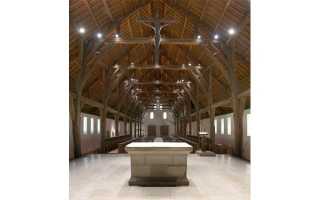
WORLD: The Abbey of Saint Wandrille in Normandy, France has opted for a white light solution from Elation Professional. The Benedictine monastery, founded in the year 648, has installed Elation TVL 3000 II dynamic white light LED luminaires in the Abbey’s church.
An important part of the Abbey is a 13th century barn that was carefully transported to the grounds by monks nearly 50 years ago to serve as the monastery’s church. The 48m long by 16m wide structure is 14m high and built of oak. The Abbey sought to improve the church’s indoor lighting with more state-of-the-art illumination but as silence plays a central role in the Benedictine tradition, absolute silence was a must.
‘There could be no noise, absolutely! The fixtures had to be completely silent,’ said Alain Cornevaux of ESL of France, lighting supplier and Elation partner on the project. ‘After contemplating and testing several fixtures, which weren’t quiet enough, they came to the conclusion that the TVL 3000 was the right choice.’
Besides the requirement that the new lighting fixtures be silent, a high quality of white light was vital as was discretion in lighting placement. ‘We proposed the TVL 3000 II dynamic white version also for its level of brightness and quality of variable white light,’ stated Jean Michel Vergniol from the ESL sales team, who worked closely with lighting designer Philippe Rabuteau from company Profil Scene on the project.
A total of 35 TVL 3000 fixtures have been mounted on a series of oak beams along the nave of the church, each fixture drawing 72W of power and using silent convection cooling technology to eliminate fan noise. ‘It also has adjustable barn doors and includes different beam angle lens kits, which were very useful during installation and positioning,’ Mr Rabuteau says of the luminaires. The fixtures blend 24x 3W white LEDs to produce a uniform projection of flat white light along the length of the church and are used to complement and match the natural light that penetrates the building from narrow rectangular and bay windows.
Maintaining the space’s architectural sanctity by discreetly placing the lighting units so they could not be seen from the baptistery was also an important requirement. When entering the Abbey church, the sightline to the altar and visual purity of the church’s oak frame has been preserved.