
Planning for success
Published: WORSHIP
We all need to be wary of false economies. Whether you’re purchasing an air ticket or a full turnkey A/V installation package, there are usually two schools of thought. The bargain basement vendor will resist parting with the cash until the very last minute, assuming that eleventh hour negotiations cannot be bettered. However, a more astute and organised traveller will check all permutations well in advance. No doubt spoiled for choice, the selection is made three months before check-in and the fact is that ticket is more than likely to be better discounted than the overpriced seats that remain empty unless snapped up for what many wrongly perceive as a fraction of the cost before take-off. In the same vein, Indonesian distributor and systems integrator turned A/V consultant, Kairos Multijaya, has a message to broadcast to venue owners – select your equipment, purchase well in advance and stick to the vision without making unnecessary changes.
The Indonesian houses of worship sector remains a lucrative seam of A/V business for those with the knowhow and technical expertise. Kairos Multijaya has been serving this community for many years and the company is well respected amongst all denominations of church in the archipelago. This is particularly true with GBI, with whom the company has enjoyed a great deal of repeat business and referrals. GBI Gilgal began life in 1996 as a 200-strong community of business people, worshipping each Sunday in a ballroom of the Plaza Central complex of Jakarta’s CBD. Over the years, it became clear that the rented space could not absorb the growing numbers, and so the church committee decided to seek a new location to permanently call home. In 2010, the church placed a bid for a plot in the Pantai Indah Kapuk area of north Jakarta, which was in an underdeveloped corridor between Ancol and Soekarno airport. The bid was accepted, and it turned out to be an astute move as the land value soared during the three year gestation period between breaking ground and completion.
At the outset, Kairos Multijaya was called upon by the church to fulfil the entire audio, video and lighting requirements in addition to acoustic works. The four-storey church dominates the skyline and is home to a Youth Fellowship hall and a main 1,000-seat sanctuary amongst many other rooms, catering facilities and outlets.
‘What made this project both different and totally refreshing was not only the fact that the church trusted us to do the entire job for them, but they stuck to the plan we designed and didn’t deviate,’ declares Kairos Multijaya A/V consultant, Leo Tanzil. ‘That made our lives so much easier. As you order the equipment well in advance you can ship the products at a reduced cost and there are no last minute dramas. In a new build you can design your systems around the architecture. This job was an absolute joy for us and broke the mould of rushing in at the last minute to try and salvage a solution on a shoestring.’
With proven expertise in audio and lighting integration, Kairos Multijaya felt confident in its abilities to embrace video design and installation in addition to acoustical work. In advance of the main sanctuary, the completion of the 400-capacity ground floor Youth Fellowship Hall served as a testing ground for its new responsibilities.
‘It was a good venue for us to start out in,’ confesses Mr Tanzil. ‘It wasn’t so much trial and error, but we were eager to see how the equipment would fully integrate.’ In terms of the audio, an RCF 4Pro system consisting of L-R 6001 three-way cabinets suspended from the ceiling and combined with TTS-28 subwoofers serves as the main PA. RCF TT25A 15-inch speakers serve as delays, whilst horizontally suspended TT08A models have been installed as under-balcony fills. An Allen & Heath iLive T80 console is used for mixing the contemporary services and an XTA DP448 processor manages the DSP capabilities. ‘Being a self-powered system, we were able to reduce cabling time and costs – it’s virtually plug-and-play,’ Mr Tanzil offers.
In order to provide sufficient brightness onto the wide screen behind the stage owing to the moving head fixtures, two Digital Projection E-Vision WXGA 7000 7000-lumens ANSI projectors have been stacked on top of one another. Having made numerous preparations in advance, the HD projection system worked perfectly. ‘We learnt to minimise the delay so that when the sound comes out, the Pastor’s mouth moves in sync,’ Mr Tanzil says.
Another interesting feature regarding the 720P resolution design, is that scalers and switchers have been removed from the video signal path. ‘We tested a few scenarios in the Youth Fellowship Hall and when we used Sony PWEX3 cameras with a Blackmagic Design Atem 1 mixer, we learnt to control the videos from a Mac,’ he explains. ‘We played a lot with the Blackmagic Design media player and discovered lots of interesting features, including the fact that you can control it via an iPad. It’s a versatile, affordable solution which allows the camera to be directly routed to the video mixer and then the projector directly. Indeed, there is very low latency.’
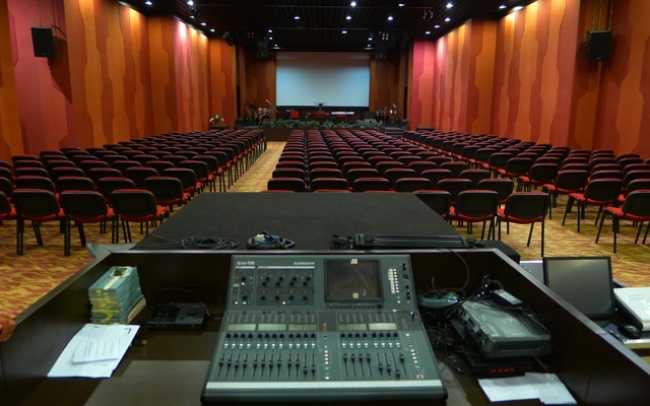
Flushed from the success of its experiments on the ground floor, the team consisting of Victor Liuwira (acoustic consultant), Mr Sandika (lighting consultant) and Mr Tanzil was elevated to the main 1,000 capacity Sanctuary. ‘Specifying the acoustic materials well in advance and carrying out the works in conjunction with the building contractor proved to be a big benefit,’ Mr Tanzil continues. The main Sanctuary is 33m in length and is furnished with carpeted floors, benefitting from two layers of acoustic treatment to the walls and celling. ‘There was no need to add extra insulation as an afterthought as we have to in so many projects. The reverberation time is around 1.4 seconds in total, which is where we wanted it to be for a performance venue at the outset. Having made all our EASE calculations beforehand, we selected the cellulose, gypsum and other acoustic fabrics within the allocated budget. As such, we didn’t have to bargain with suppliers on a tight deadline – it makes a lot of difference and we passed this benefit onto the customer.’
A six per-side Meyer Sound Mica line array system is supplemented by four HP700 subwoofers that have been centrally clustered into the lip of the 1m high concrete stage. ‘By designing this in advance, we could ask the building contractor to create voids in the concrete for the subwoofers,’ says Mr Tanzil. A further six UPM speakers have also been recessed into the lip of the stage for the front-fills, whilst the balcony area is served by four ceiling suspended UPJ models. MAPP on-line simulation software dictated the final speaker selection and positioning, whilst SIM3 software was used during tuning.
‘Like the RCF system downstairs, the Meyer Sound speakers are self-powered. They are often associated with the best theatrical productions in the world and as such many people associate Meyer Sound with being expensive. However, when you calculate the savings in amplification and installation costs such as cabling and manpower, together with the long run up time we had in placing the order before installing the speakers, there wasn’t much of a difference.’
Completing the audio set-up, an Allen & Heath iLive T-112 console is used for mixing the services at the extensive 11.7m x 2.5m rear production area. The production area is another interesting facet of the project that was specified by Kairos Multijaya around the time when the ground breaking ceremony was taking place.
‘Often, we are asked to create control rooms in impossible places and as such the audio is always compromised. Here at GBI Gilgal, we wanted to create the perfect production area for the volunteers and I believe that we have achieved that.’
The system is straightforward in that the console is connected to a back of house iDR-64 Mix-Rack, into which all the microphone inputs from the stage including the RCF TT25SMA stage monitors and five Allen & Heath ME-1 personal mixers are connected. A Meyer Sound Galileo Callisto 616 processor conducts the signal processing requirements in the venue, whilst an Apogee Big Ben digital clock syncs all the audio. The addition of the external clock greatly improves the sonic quality of the mixing console. On stage, the choir uses six pole mounted Rode M3 microphones, whilst Shure SM58a ULX-D wireless models are preferred by the other musicians and singers. A DPA d:fine omni-headset microphone with a double-ear mount has been selected for preaching by Pastor Juan Mogi. Klotz MC2000 cables were exclusively chosen for the instruments and MC5000 cabling for the main loudspeakers and other fixed audio devices.
Having specified Cat-5 cabling to run throughout GBI Gilgal during its conception proved to be huge advantage when switching on the video devices at the time of commissioning. ‘All the television sets throughout the venue are connected to the production area and receive the main feed via the Cat-5 IP network,’ Mr Tanzil elucidates. Like the audio, the video section of the production area is very clean and simple. A central 8m wide x 5m high definition LED screen on the stage is served by a showtech 7mm pitch SMD LED, whilst two L-R 4.8m x 3.0m fix Remaco screens are catered for Barco HDX-W12 12,000 lumens projectors.
‘The challenges here were to make sure that the screens didn’t pixelate towards the front, that the Pastors’ mouth was synced with the audio and that the L-R screens, the central screen and the preview displays were similar in colour and tone,’ furthers Mr Tanzil. ‘We achieved those goals. The screens were calibrated using CalMan 5 software with X-rite i1 pro colorimeter and this allowed us to get the proper brightness, contrast and colour profile.’
The inputs feeding the video screens and TV screens throughout include a Blu-Ray DVD player, three Sony PWEX3 HD cameras affixed to Libec TH-DV950 broadcast tripods and three Mac mini computers. The Macs are coordinated, arranged and sequenced in a logical manner as presentation, lyric Text and background source using the Pro Presenter 5 software. A Radial Duplex MK4 stereo direct box has been added to the signal chain from mac mini to ensure the iLive T-112 console receives the same impedance output, which acts as a filter ensuring no signal degradation and a guarantee that no computer noises will be heard on the main PA system.
Having visited Broadcast Asia in 2011 on a fact finding mission, Mr Tanzil was enlightened by his visit to the Blackmagic Design booth. ‘I realised afterwards that we could really simplify the signal chain and in doing so minimise video installation costs by employing an ATEM 1 solution,’ he says. Connected via Ethernet, two ATEM 1 M/E Broadcast Panels provide switcher control including the three cameras, transitions, keyers, fader and DVE control. They bypass the need to incorporate any scalers or converters by utilising two very cost effective ATEM 1 production switchers, each of which comes with four HD SDI and four HDMI inputs, together with HD SDI, HDMI and analogue outputs. Furthermore, both ATEM 1a switchers are future-proofed, with several of the SDI and HDMI ports still unused. In addition to creating a matrix, the resultant system enables keying, and layering. An LVP605 video processor receives HD video input from the Atems and sends it the LED Screen. Four port HDMI splitters and extenders take the feeds from the HD mixer, outputting the resulting converted signal to the multiple screens throughout the church over the IP network, having converted the HDMI signal. In doing so the Kairos Multijaya team provided an HDMI over IP solution at an affordable price.
Elsewhere, a simple but effective Fine Art lighting system comprises 22 moving heads, nine fresnels and 12 ellipsoidal fixtures on the overhead trusses, all controlled by an Avolites Titan console.
Ultimately, the airline ticket that was issued and the subsequent journey taken turned out to be somewhat effortless. The fare wasn’t subject to hidden surcharges or penalties and, having experienced this class of travel, future journeys are recommended to be taken in this manner.
‘We listened to the client, learned what they wanted and GBI Gilgal were determined to stick with the vision that they’d created,’ concludes Mr Tanzil. As the liaison between the church and the consultant / contractor, Viah Pioh should take credit in his role in that he did not deviate from the path set before him. ‘The design we created three years ago was perfect when we installed it in 2013, as nothing had really changed.’ Technology rarely stands still and neither do fares, but by hedging bets in advance, unnecessary problems are avoided.